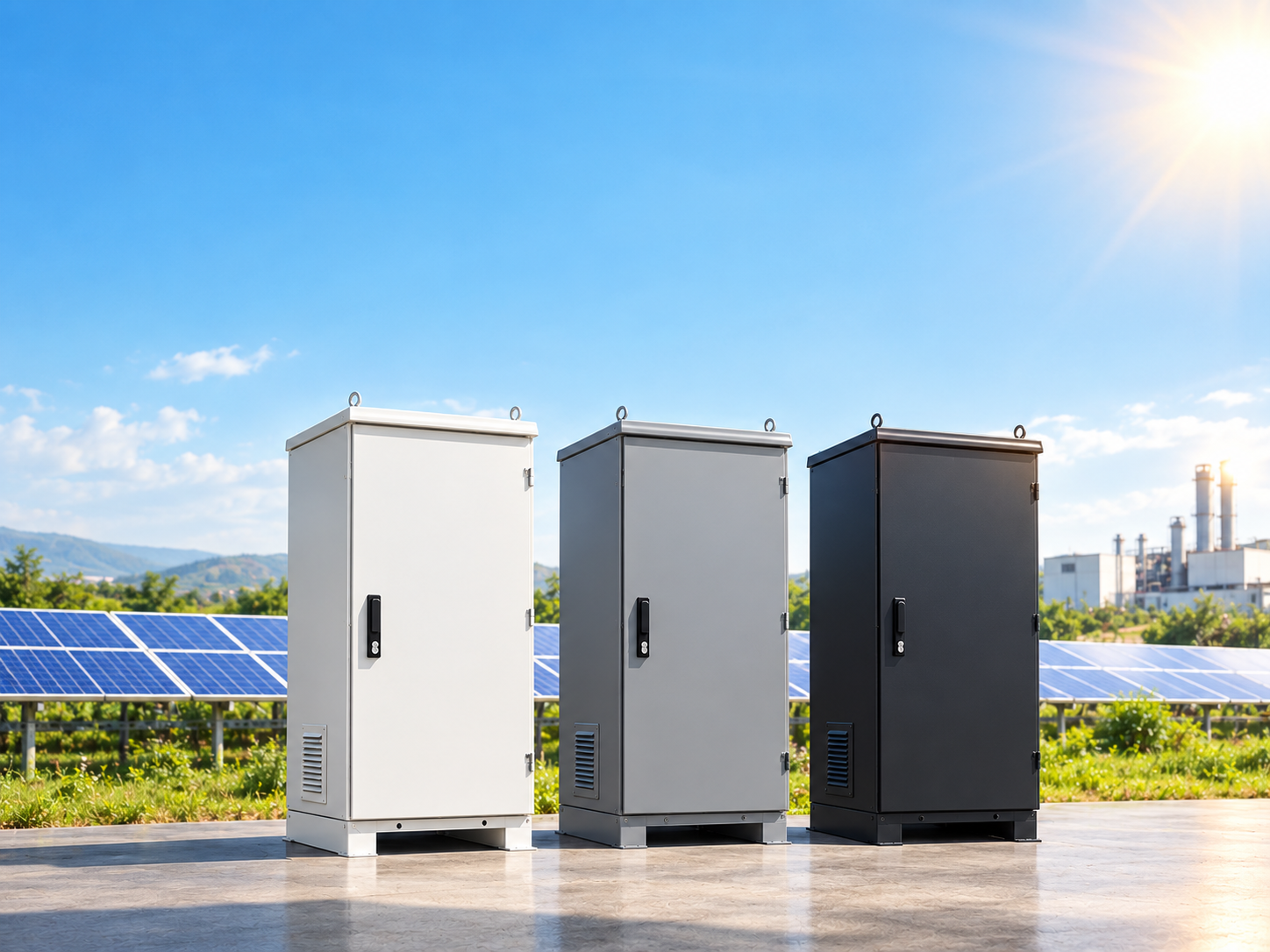
An outdoor electrical enclosure is expected to do many things at once.
It protects equipment from dust, rain, moisture, corrosion, UV exposure, accidental contact, and harsh environmental conditions. But there is another role that is often overlooked:
An enclosure is also part of the thermal system surrounding electrical equipment.
This becomes particularly important in outdoor applications where enclosures are exposed to direct sunlight for long periods.
A white enclosure, a grey enclosure, and a black enclosure may have the same dimensions, same material, same IP rating, and contain identical equipment — yet their thermal behaviour outdoors can be different.
The reason is simple:
Colour affects how much solar energy an enclosure absorbs.
That absorbed energy changes the enclosure surface temperature, influences internal heat gain, and can affect the operating conditions of the equipment installed inside.
For applications in renewable energy, utilities, telecom, infrastructure, industrial plants, water treatment, EV charging, and outdoor automation systems, enclosure colour is not just an aesthetic choice.
It can become an engineering parameter.
When solar radiation strikes an enclosure surface, the energy is divided into two parts:
Light-coloured surfaces generally reflect more solar radiation.
Dark surfaces generally absorb more solar energy.
The absorbed energy converts into heat, increasing the surface temperature of the enclosure.
This heat then moves through the enclosure structure and influences the internal environment.
A simplified thermal path looks like this:
Sunlight → Enclosure Surface → Enclosure Wall → Internal Air → Electrical Equipment
This means that the enclosure itself becomes part of the heat transfer system.
For outdoor electrical enclosures, thermal design therefore involves two heat sources:
The enclosure has to manage both.
The external surface of an enclosure can become significantly hotter than ambient air when exposed to direct sunlight.
A darker enclosure exposed to strong solar radiation may experience higher surface temperatures compared with a lighter-coloured enclosure under the same conditions.
This additional heat can:
This is especially relevant for:
In these applications, thermal management becomes as important as ingress protection.
When discussing enclosure colour, two engineering terms are important:
This describes how much solar radiation a surface absorbs.
Higher absorptivity generally means:
This describes how effectively a surface radiates heat away.
An enclosure continuously exchanges heat with its surroundings through:
Therefore, actual enclosure temperature depends on multiple factors:
This is why colour alone does not determine enclosure performance.
It is one variable within a larger thermal design equation.
White and lighter shades generally reflect a larger portion of solar radiation.
Benefits can include:
For outdoor installations in high-solar regions, light-coloured finishes are often considered where thermal performance is important.
Applications may include:
However, colour alone cannot compensate for high internal heat generation.
Cooling calculations remain essential.
Grey is one of the most common industrial enclosure colours.
Reasons include:
However, not all grey finishes behave the same.
Different coating technologies, pigmentation, and surface finishes can influence solar performance.
A light grey enclosure and a dark grey enclosure may not experience identical thermal behaviour.
When enclosure temperature is critical, specifying only "grey" may not be enough.
Surface properties matter.
Black surfaces generally absorb more solar energy than lighter colours.
This can result in:
This does not mean black enclosures cannot be used outdoors.
It means that thermal design must account for additional solar loading.
Possible solutions include:
Engineering decisions should be based on operating conditions rather than colour alone.
A common misconception is that a high IP rating automatically means better outdoor performance.
An enclosure may have:
and still face thermal challenges in direct sunlight.
IP ratings primarily indicate protection against:
They do not indicate:
This is why thermal analysis and ingress protection should be considered separately.
A successful outdoor enclosure design addresses both.
For engineers and system designers, enclosure selection should begin with the operating environment.
Important factors include:
Maximum operating temperatures should be considered rather than average conditions.
Orientation affects thermal loading.
Heat generated by equipment should be estimated.
Examples:
Cooling options may include:
Factors include:
Thermal management is not solved by a single feature.
It requires system-level thinking.
Sometimes the most effective cooling solution is reducing solar exposure itself.
Methods include:
Reducing solar radiation at the source can lower the cooling requirement for the entire system.
This approach is widely used in telecom, utility, and infrastructure applications.
In countries with high solar intensity, outdoor equipment often operates in challenging environments.
Typical conditions may include:
For outdoor electrical systems, enclosure thermal design can directly influence:
As renewable energy, EV infrastructure, telecom networks, and industrial automation continue to expand, outdoor enclosures are expected to perform under increasingly demanding conditions.
That performance starts with engineering decisions made long before equipment is installed.
The right outdoor enclosure is not selected only by:
It is selected by understanding:
Environment → Solar Load → Internal Heat → Thermal Path → Cooling Strategy → Equipment Performance
This systems-based approach helps create more reliable outdoor installations.
Because an enclosure is not simply a protective box.
It is the thermal boundary around critical electrical equipment.
And in outdoor applications, that boundary begins with the surface facing the sun.
1. Does enclosure colour affect temperature?
Yes. Surface colour influences how much solar radiation is absorbed, which can affect enclosure surface temperature and thermal loading
2. Are white enclosures better for outdoor use?
Light-coloured surfaces generally absorb less solar heat compared with darker surfaces, but enclosure selection should also consider internal heat generation and cooling methods.
3. Does IP65 mean the enclosure is suitable for direct sunlight?
No. IP ratings indicate protection against dust and water ingress, not thermal performance under solar exposure.
4. Can black electrical enclosures be used outdoors?
Yes. However, additional thermal management such as ventilation, cooling, or shading may be required depending on the application.
5. What factors influence outdoor enclosure temperature?
Solar radiation, ambient temperature, colour, coating, internal heat generation, ventilation, wind, and enclosure design all contribute.
At Brick and Byte, outdoor enclosure design goes beyond ingress protection.
Applications across utilities, renewable energy, telecom, infrastructure, industrial manufacturing, water treatment, and mission-critical installations require enclosures designed for actual operating environments.
This includes consideration of:
From industrial enclosures and outdoor electrical panels to telecom cabinets and specialised enclosure systems, the objective remains the same:
Design enclosures not only to withstand the environment — but to perform within it.
To discuss outdoor enclosure solutions, thermal considerations, or custom-engineered enclosure systems, connect with Brick & Byte:
???? [email protected]
???? Brick and Byte Official Website
Brick and Byte Limited
Electrical, Power, Energy Infra & Digital Infra Solutions
Design. Build. Integrate. Operate. One Partner.