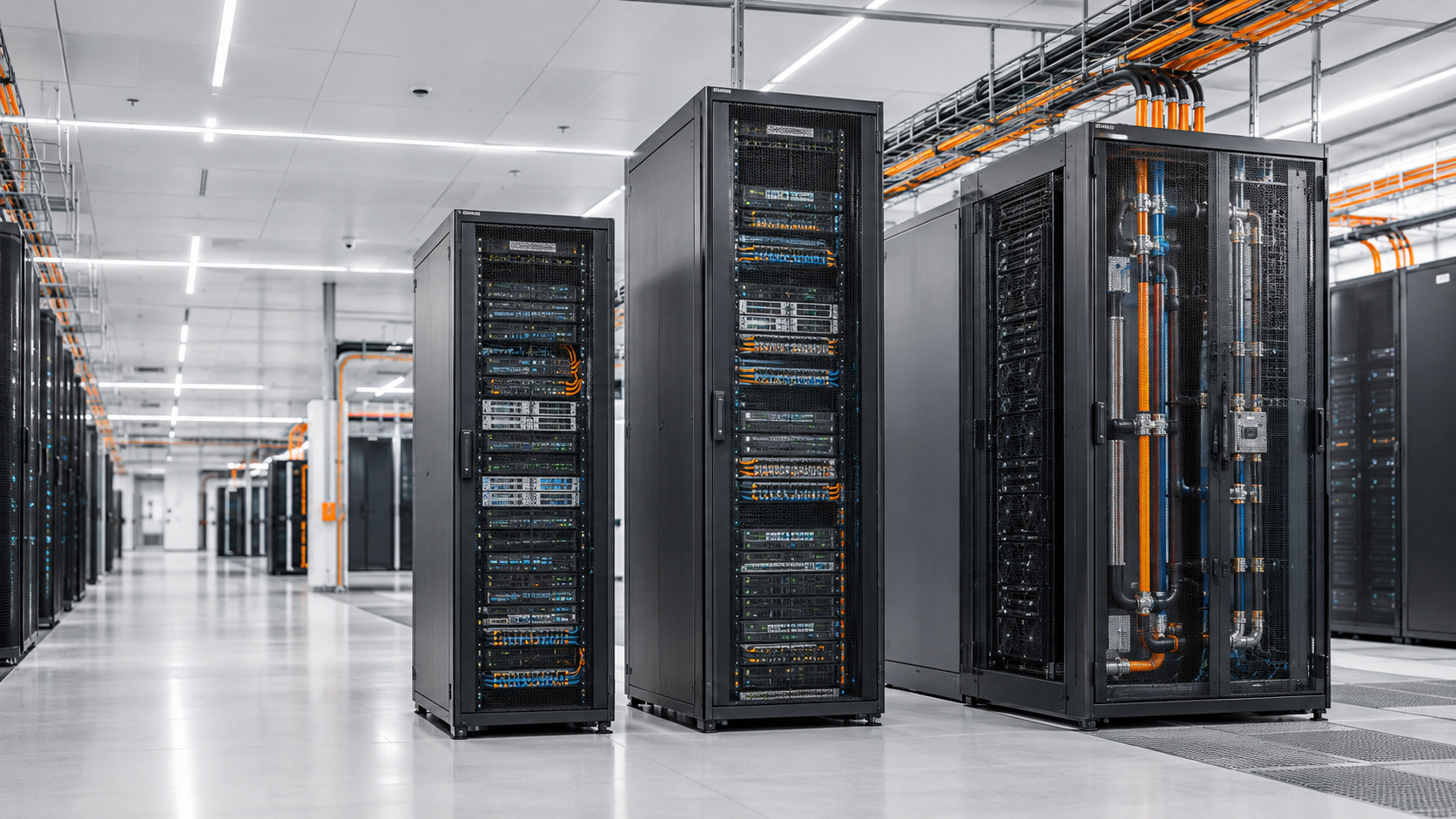
For years, the 42U server rack has been one of the most familiar standards in data centres, server rooms and IT infrastructure. It offered a practical balance between equipment capacity, accessibility, cooling and installation height.
But modern IT infrastructure is changing.
Higher server densities, larger networking equipment, increasing rack power requirements, advanced cable management and liquid cooling are changing what organizations expect from a rack. As a result, 48U server racks, wider and deeper rack enclosures, and application-specific custom racks are becoming increasingly relevant.
The important shift is not simply from 42U to 48U.
It is the move from treating a rack as a standard cabinet to treating it as an engineered part of the infrastructure.
A rack unit, or U, represents 1.75 inches (44.45 mm) of vertical mounting height.
That means:
The 42U format became widely adopted because it provides substantial equipment capacity while remaining practical for installation, maintenance and data-centre layouts.
However, rack selection has never been only about height.
Width, depth, load capacity, airflow, cable routing, PDU mounting, door configuration, floor loading and cooling requirements all influence whether a rack is suitable for a particular deployment.
Modern infrastructure is making these factors increasingly important.
The most visible development is the increasing use of 48U rack cabinets.
Six additional rack units may appear relatively small, but across a large data-centre deployment, that additional vertical capacity can become significant.
A 48U rack can provide additional space for:
Major infrastructure manufacturers already offer 48U configurations.
Dell Technologies, for example, has offered 42U and 48U rack configurations across its rack portfolio, including standard, wide and deep options. Vertiv also offers 48U rack configurations designed for high-density infrastructure. Schneider Electric has introduced 48U rack solutions for high-density and AI-oriented deployments.
This shows that 48U is not replacing 42U universally.
Instead, rack selection is becoming more application-driven.
The difference between the two is more than six additional mounting positions.
A 42U rack provides less vertical mounting space.
A 48U rack provides six additional U, which can accommodate additional servers, switches, cable-management components or other rack-mounted equipment.
For deployments where rack space is already heavily utilized, those additional units can provide useful headroom.
A taller rack can allow more equipment to be consolidated within the same floor footprint.
However, higher equipment density also means higher potential power and thermal density.
Therefore, increasing rack height should always be considered alongside cooling and power requirements.
If additional equipment can be installed vertically, organizations may be able to avoid adding another rack.
That can have implications for:
The actual benefit depends on the facility design and available infrastructure.
More equipment in a single rack can increase the importance of accessibility.
Rack height, equipment placement, vertical cable management and service clearances should therefore be considered during rack planning.
A higher rack should not simply mean more equipment packed into less space.
It should mean better utilization without compromising maintainability.
The evolution of racks is not limited to 42U versus 48U.
Rack width and depth are becoming equally important.
Traditional rack configurations commonly use 600 mm widths, but wider 700 mm and 800 mm rack configurations are available for applications requiring additional side space.
Greater width can provide more room for:
Depth is also becoming increasingly important as servers and networking equipment become more substantial.
Deeper racks can provide additional space for:
Vertiv, for example, offers rack configurations with different widths and depths, demonstrating how modern rack architecture is moving beyond a single standardized cabinet dimension.
One of the biggest forces behind this evolution is AI and high-performance computing.
AI servers can have substantially higher power and thermal requirements than conventional enterprise IT equipment.
That creates a chain reaction.
Higher computing power leads to higher electrical consumption.
Higher electrical consumption produces more heat.
More heat requires more sophisticated cooling.
And advanced cooling changes the mechanical requirements of the rack.
This is why modern high-density racks may require:
Schneider Electric's NetShelter Open Architecture MGX rack, for example, is a 48U rack designed for high-density AI infrastructure and supports direct liquid-cooling architectures.
The rack is therefore becoming part of the power and thermal-management strategy, rather than simply a mounting structure.
Not every application can be accommodated efficiently by a standard 42U or 48U cabinet.
This is where custom server racks and engineered rack enclosures become important.
Customisation may be required when the application involves:
Specialized industrial, telecom, networking or computing equipment may not follow conventional rack layouts.
A custom enclosure can be designed around the actual equipment dimensions.
High-density computing may require dedicated airflow paths, rear-door heat exchangers or liquid-cooling integration.
The rack can be engineered to accommodate the required cooling architecture.
Modern data centres can contain significant volumes of fibre, copper and power cabling.
Custom rack designs can provide dedicated vertical and horizontal cable-routing provisions while maintaining appropriate bend radii and service access.
AI servers, storage systems and power equipment can significantly increase rack loading.
Custom rack construction can be designed around the required static and dynamic load conditions.
A rack may need specific PDU locations, busbar integration or other power-distribution arrangements.
These requirements can influence the rack's internal layout and available mounting space.
A rack used inside a controlled data centre has very different requirements from one deployed in a telecom room, industrial facility or edge environment.
Protection, ventilation, ingress requirements and environmental conditions may therefore influence the enclosure design.
Instead of asking "Which rack size is better?", engineers should ask "Which rack configuration suits the application?"
A 42U rack remains an excellent choice when:
A 48U rack becomes attractive when:
A custom rack becomes more appropriate when:
The objective is not to maximize the number of devices inside a rack.
The objective is to achieve the right balance between density, power, cooling, accessibility, reliability and future expansion.
Before specifying a modern server rack or data-centre rack enclosure, several parameters should be evaluated.
Rack height: How much equipment needs to be installed today, and how much expansion is expected?
Rack width: Is a standard 600 mm cabinet sufficient, or is additional space needed for cables and power?
Rack depth: Can the rack accommodate current and future equipment along with cable-management requirements?
Load capacity: What are the static and dynamic equipment loads?
Power density: How much electrical power will the rack consume?
Cooling: Can conventional airflow cooling handle the thermal load, or will advanced cooling be required?
Cable management: How will power, copper and fibre cables enter, route and exit the rack?
Serviceability: Can technicians safely access equipment without disrupting adjacent systems?
Future readiness: Can the rack accommodate changes in servers, networking, power or cooling technologies?
These questions become particularly important as data-centre infrastructure becomes denser and more complex.
The evolution from 42U to 48U and custom rack configurations does not mean that 42U racks are becoming obsolete.
Instead, it reflects a broader transformation in infrastructure design.
Modern racks increasingly need to support equipment mounting, power distribution, thermal management, connectivity, cable management, physical protection and future expansion within one coordinated architecture.
For conventional deployments, 42U may remain the right choice.
For higher-density installations, 48U can provide valuable additional vertical capacity.
For specialized AI, liquid-cooled, telecom, industrial or edge applications, a custom rack can provide the flexibility that standard dimensions cannot.
The future of rack infrastructure is therefore unlikely to be defined by one universal size.
It will be defined by application-specific engineering.
At Brick & Byte, rack and enclosure solutions can be engineered around application requirements including equipment dimensions, power distribution, cable management, cooling integration, load requirements and deployment environment.
From standard rack configurations to high-density and custom engineered enclosures, the focus is on creating infrastructure that supports current requirements while allowing room for future technologies.
Looking for engineered rack and enclosure solutions for data centres, telecom, industrial or high-density applications?
Connect with Brick & Byte to discuss your requirements.
Website: www.brickandbyte.in
Email: [email protected]
No. Both remain relevant. The appropriate rack depends on equipment density, facility constraints, cooling, load capacity and future expansion.
A 48U rack provides six additional rack units, equivalent to approximately 10.5 inches or 267 mm of additional mounting height.
Yes, 48U racks can be used for AI infrastructure, provided the rack is designed to handle the required power, weight, cooling and cable-management requirements.
Custom racks are useful when equipment dimensions, cooling, power distribution, load requirements, cable routing or environmental conditions cannot be efficiently accommodated by a standard rack.
No. Rack height is only one design parameter. Power density, cooling, equipment weight, serviceability, cable management and available room height must also be considered.