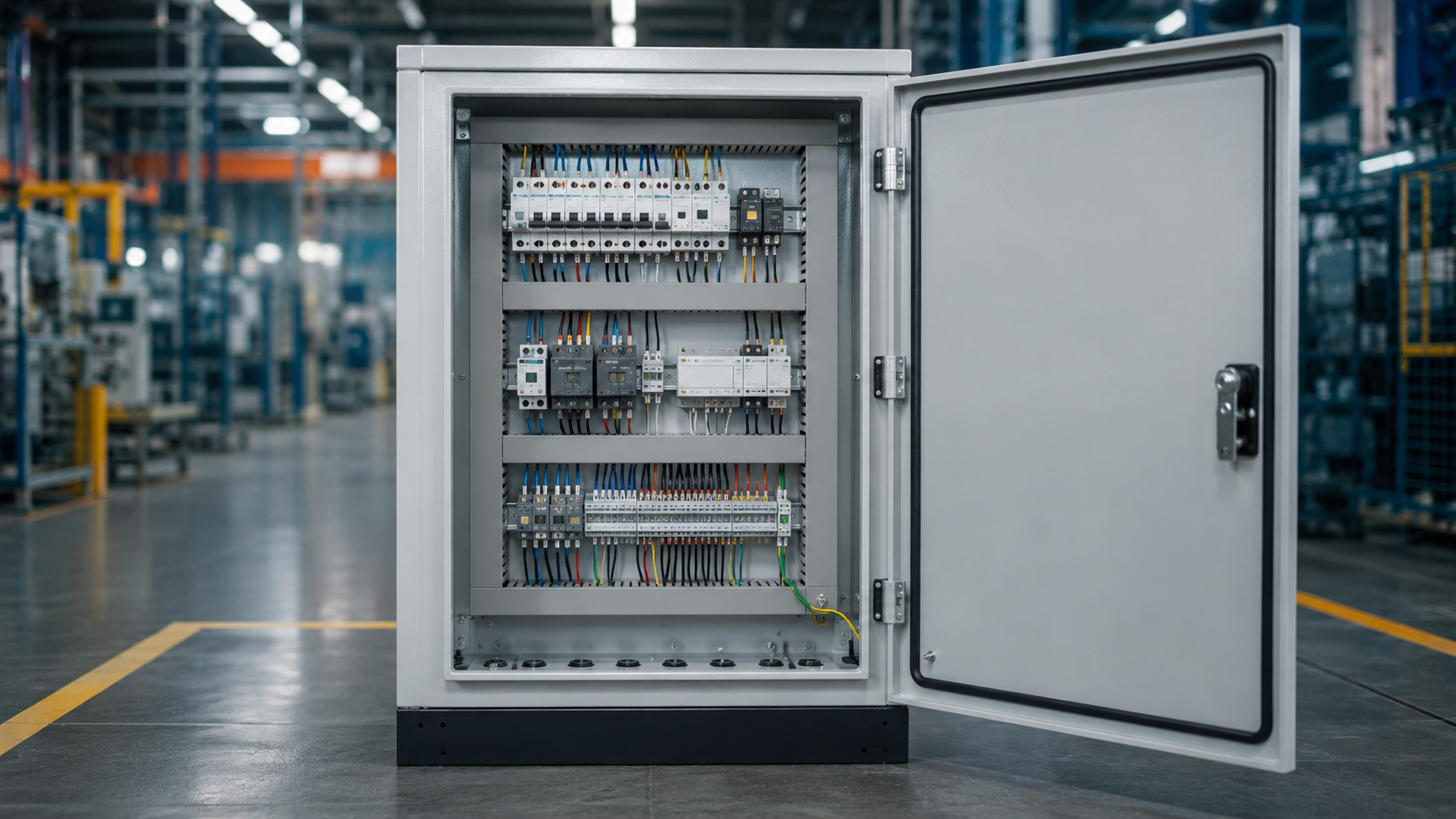
An industrial enclosure can look perfectly fine after years of service. The paint is intact. The door closes. The latch still works.
But what happens when that door has been opened and closed 10,000 times?
For electrical panels, industrial control cabinets, outdoor electrical enclosures, telecom cabinets, and data center infrastructure, repeated door operation creates a form of mechanical aging that is easy to overlook. Hinge fatigue, gasket compression, latch wear and door misalignment can gradually affect protection, safety and usability.
This is why enclosure reliability is not only about IP rating, material thickness or surface finish. It is also about how the enclosure performs after thousands of real-world operating cycles.
In this article, we look at what happens to an enclosure after 10,000 door cycles and why mechanical design matters for long-term enclosure performance.
A door cycle generally means one complete opening and closing operation.
For an industrial electrical enclosure, a cycle could involve:
Open → access equipment → close → latch
Consider an enclosure installed in a manufacturing facility where technicians access a control panel several times every working day.
Even at just 10 cycles per day:
10 cycles × 300 working days = 3,000 cycles/year
Over several years, the door can easily accumulate thousands of operations.
In applications such as MCCs, control panels, automation cabinets, telecom cabinets and maintenance-heavy industrial systems, the number can be significantly higher.
The important question isn't simply whether the door works after 10,000 cycles.
It is whether it still closes correctly, seals consistently, latches securely and maintains the enclosure's intended protection.
Every time an enclosure door moves, its hinges carry the door's weight and guide its movement.
With repeated operation, several things can occur:
Hinge pin wear
Increased friction
Loosening of mounting points
Deformation under heavy door loads
Slight changes in door position
Increased door sag
The effect may initially be almost impossible to notice.
The door may still close, but it may require slightly more force or need to be lifted before the latch engages.
For larger electrical enclosures, this becomes more important because doors can become heavy due to:
Mounting plates
HMIs
Meters
Push buttons
Cooling equipment
Cable management components
Additional accessories
A poorly selected hinge system can therefore turn a relatively simple enclosure into a maintenance issue over time.
Hinge geometry, material, load capacity and mounting method all influence enclosure life.
An enclosure gasket is designed to create a controlled seal between the door and the enclosure body.
In an IP55, IP65 or IP66 enclosure, the gasket plays an important role in maintaining protection against dust, water and environmental contaminants.
But gaskets are continuously subjected to mechanical compression.
Every door cycle changes the compression condition.
Over thousands of cycles, the gasket may experience:
Compression set
Surface wear
Hardening
Loss of elasticity
Cracking
Local deformation
This doesn't necessarily mean the gasket suddenly fails at cycle 10,000.
Instead, sealing performance can gradually deteriorate.
A door that once required consistent compression around its entire perimeter may eventually develop small areas where the gasket no longer contacts the frame properly.
For outdoor electrical enclosures, this can become particularly important.
Rain, dust, humidity and temperature changes can expose weaknesses in the sealing system that aren't visible during a simple visual inspection.
That's why enclosure sealing performance should be considered as a system rather than simply specifying an IP rating on the datasheet.
The latch is responsible for keeping the door securely closed and maintaining the required compression against the gasket.
Repeated operation can cause:
Latch mechanism wear
Reduced locking force
Increased handle play
Misalignment between latch and keeper
Difficulty in engaging the latch
Loose or inconsistent closing
A common warning sign is simple:
The door still closes, but it doesn't feel the same.
Technicians may need to push harder, pull the door tighter or adjust the handle before locking it.
That extra effort is not necessarily just an inconvenience.
It can indicate that the enclosure's mechanical tolerances are changing.
For electrical control cabinets and industrial enclosures, reliable latching is particularly important because the door may need to maintain consistent gasket compression while also preventing unwanted access.
Door alignment is often treated as a cosmetic issue.
It isn't.
A door that moves out of alignment can affect multiple enclosure functions simultaneously.
For example:
Hinge wear → Door sag → Uneven gasket compression → Latch misalignment → Reduced sealing performance
This creates a chain reaction.
One small mechanical change can eventually influence the entire enclosure door system.
Alignment problems may show up as:
Uneven gaps around the door
Door rubbing against the frame
Latch requiring excessive force
Gasket compression varying around the perimeter
Difficulty opening or closing the door
Visible door sag
This is particularly relevant for large-format electrical cabinets, floor-standing enclosures and modular panel systems, where door dimensions and weight can be substantial.
The number 10,000 cycles sounds impressive, but the number alone doesn't tell you whether an enclosure is reliable.
Two enclosures can both survive 10,000 cycles while having completely different mechanical performance.
The better question is:
What condition is the enclosure in after 10,000 cycles?
A meaningful durability evaluation can look at:
| Component | What to Check |
| Hinges | Wear, play and door sag |
| Gasket | Compression, elasticity and continuity |
| Latch | Engagement and locking force |
| Door | Alignment and deformation |
| Frame | Mounting integrity |
| Finish | Wear around contact areas |
| Sealing | Consistency around the perimeter |
This approach moves enclosure testing beyond simply asking whether the door can still open.
Major industrial manufacturers such as Schneider Electric, ABB, Siemens and Eaton operate in environments where electrical equipment may be accessed repeatedly throughout its service life.
Their enclosure and switchgear ecosystems demonstrate an important principle:
Electrical performance depends partly on mechanical reliability.
Whether the application is an industrial automation cabinet, low-voltage switchboard, motor control center, telecom cabinet or data center infrastructure, technicians need predictable access.
An enclosure door isn't merely a sheet-metal component.
It is part of the equipment interface.
A poorly functioning door can increase maintenance time, compromise sealing, create frustration for technicians and eventually contribute to enclosure reliability problems.
Long-life enclosure design starts well before the first door is installed.
Hinge Selection
Hinges should be selected based on:
Door weight
Door dimensions
Expected operating cycles
Environmental conditions
Required opening angle
Mounting configuration
Gasket Design
The gasket should provide controlled compression without excessive deformation.
Important considerations include:
Material
Profile
Compression ratio
Temperature range
Environmental exposure
Replacement accessibility
Latch Design
A reliable latch should maintain secure engagement without requiring excessive force.
For maintenance-heavy applications, ergonomics also matter.
Structural Design
Door stiffness, frame rigidity and mounting accuracy all contribute to long-term alignment.
A strong enclosure body cannot compensate for a poorly designed door system.
Cycle testing is valuable because it converts an everyday action into a measurable durability test.
Instead of saying:
"The door is designed for long life."
Manufacturers can ask:
"How does the door perform after thousands of operations?"
That difference matters.
For an enclosure used occasionally, 10,000 cycles may represent many years of service.
For an enclosure accessed frequently, those cycles can accumulate much faster.
The right enclosure therefore depends not only on IP protection, material and dimensions, but also on the application's maintenance frequency and operating environment.
An enclosure doesn't necessarily fail dramatically after 10,000 door cycles.
More often, reliability declines gradually.
Individually, these changes may seem minor.
Together, they can affect sealing, accessibility, maintenance and long-term enclosure performance.
That is why durable enclosure design should consider the complete door mechanism—not just the enclosure body.
For industrial applications, the best enclosure is not simply one that looks robust on day one.
It is one that continues to perform after years of opening, closing, servicing and environmental exposure.
1. What is a door cycle in an electrical enclosure?
A door cycle generally means one complete opening and closing operation of the enclosure door.
2. Does 10,000 door cycles mean the enclosure will last 10,000 operations?
Not necessarily. Cycle life depends on the hinges, gasket, latch, door weight, construction and operating environment.
3. Why do enclosure gaskets degrade?
Repeated compression, temperature changes, environmental exposure and material aging can cause gasket hardening, compression set and loss of elasticity.
4. How can you identify enclosure door misalignment?
Common signs include uneven door gaps, rubbing, difficult latching, excessive closing force and inconsistent gasket compression.
5. How can enclosure door life be improved?
Using correctly rated hinges, durable gaskets, reliable latches, rigid door construction and proper alignment can significantly improve long-term mechanical performance.
At Brick and Byte, we design and manufacture industrial enclosure solutions for demanding electrical and digital infrastructure applications, with a focus on mechanical durability, protection, accessibility and application-specific requirements.
From industrial electrical enclosures to infrastructure solutions, the goal isn't simply to build an enclosure that works today—but one designed to keep working tomorrow.
Looking for an enclosure designed around your application?
Email: [email protected]
Website: www.brickandbyte.in
Brick and Byte — Engineering the Future.


Why Internal Equipment Placement Makes or Breaks Reliability
Read More