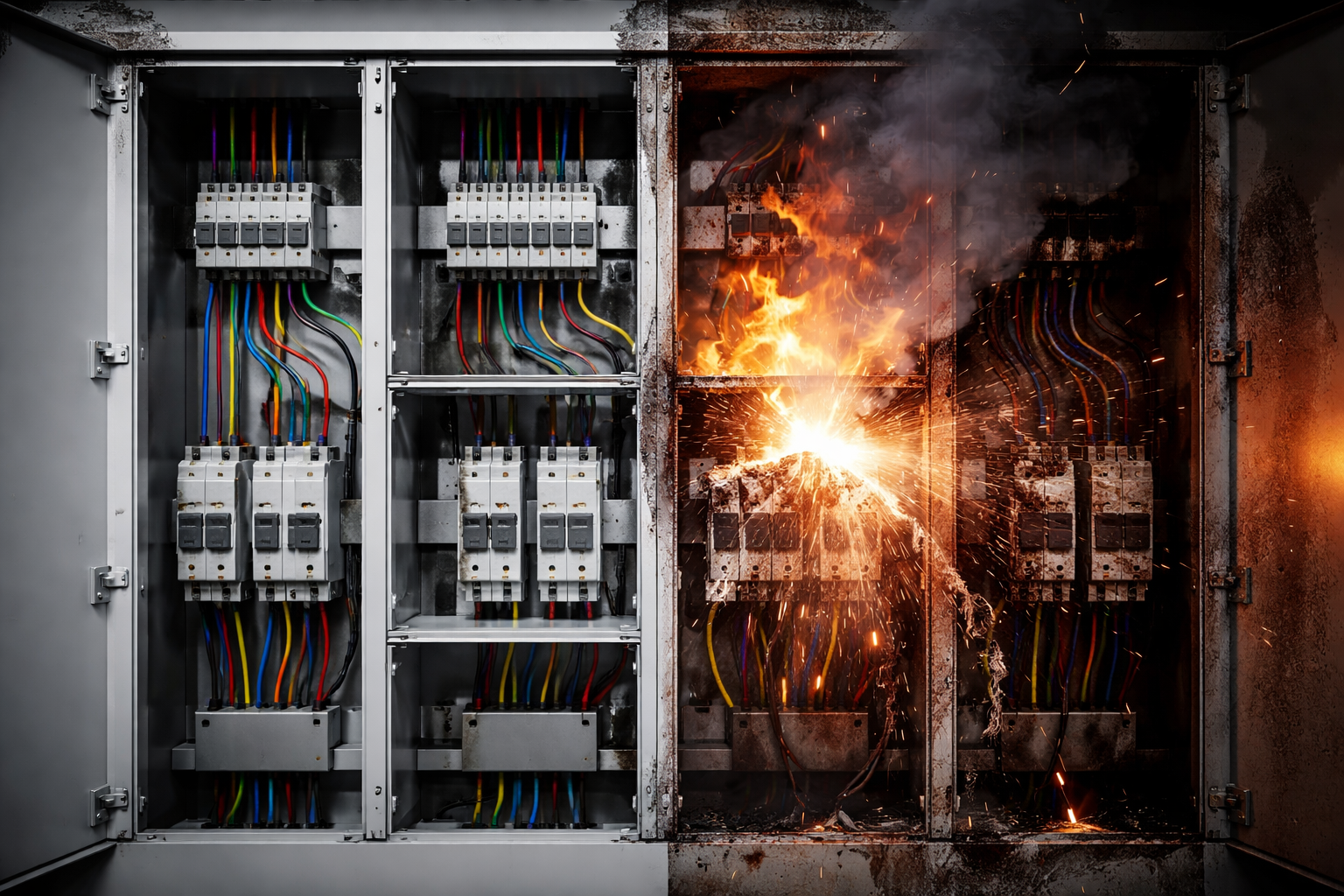
“It’s a Form 4 panel—so it’s safe.”
This belief is widespread across the electrical industry. Consultants specify it, OEMs promote it, and end users trust it. But the reality is far more nuanced—and potentially dangerous.
Form 4 segregation, as defined under IEC 61439, is often mistaken for a safety feature. In truth, it is primarily a design approach for internal separation, not a guarantee of fault containment or system protection.
Understanding this distinction is critical, especially in high-risk and high-reliability environments such as data centers, utilities, and industrial plants.
Form 4 is the highest level of internal segregation defined under IEC 61439.
It ensures:
Separation of busbars from functional units
Separation of functional units from each other
Separation of terminals from busbars and functional units
Individual compartments for outgoing feeders
This design improves:
Accessibility during maintenance
Reduction in accidental contact with live parts
Limited operational continuity during servicing
However, it is important to note:
Form 4 defines how components are arranged—not how faults behave.
The industry often assumes that higher segregation automatically means higher safety.
Faults remain confined within compartments
Other sections continue operating safely
Equipment damage is localized
Faults, especially arc faults, generate extreme energy
Heat, pressure, and plasma can breach internal partitions
Damage can propagate across compartments
Form 4 improves operational safety during maintenance—but it does not inherently protect against fault energy.
The most critical risk inside LV switchboards is the internal arc fault.
During an arc fault:
Temperatures can exceed 20,000°C
Rapid pressure buildup occurs inside the enclosure
Metal vaporizes and becomes conductive plasma
Shockwaves can deform or rupture panel structures
Standard Form 4 partitions:
Are not pressure-rated
Are not tested for arc containment
Cannot reliably withstand arc blast forces
This is where the gap between segregation and real safety becomes evident.
A major electrical failure in San Francisco caused widespread outages and equipment damage. The incident involved internal faults within substation infrastructure, leading to fire and explosion.
While not attributed to segregation design alone, the event demonstrated a key reality:
Once fault energy escalates, internal separation does not prevent damage propagation
During Hurricane Harvey, loss of power led to cascading failures in critical systems at the Arkema facility. Electrical system failures contributed to fires and explosions.
This incident highlights:
System resilience depends on fault handling and containment, not just physical separation
Electrical infrastructure must be designed for failure scenarios, not just normal operation
According to OSHA:
Thousands of arc flash incidents occur annually
Many incidents happen within enclosed electrical panels
Severe injuries occur despite the presence of structured switchgear
This reinforces:
Enclosure and segregation alone do not eliminate arc risk.
NFPA guidelines emphasize:
Arc flash temperatures can exceed the surface of the sun
Standard switchboard constructions are not designed to contain arc energy
Safety strategies focus on mitigation, PPE, and system design, not segregation
IEEE studies on switchgear failures show:
Internal arc pressure can rupture partitions
Hot gases can spread across compartments
Segregation does not stop arc propagation unless specifically tested
Conclusion:
Mechanical separation is not equivalent to arc containment.
| Aspect | Form 4 Segregation | Arc-Resistant / Fault-Engineered Design |
| Objective | Component separation | Fault containment and energy control |
| Standard Basis | IEC 61439 | Arc fault testing standards and protocols |
| Protection Type | Against accidental contact | Against arc blast and thermal energy |
| Barrier Strength | Standard sheet metal partitions | Reinforced, pressure-tested enclosures |
| Arc Handling | Not defined | Controlled venting and containment |
| Fault Propagation | Possible | Minimized and directed |
| Operator Safety | Moderate | High (when tested) |
Form 4 panels are often over-relied upon because they are:
Visibly structured and organized
Associated with “higher specification”
Easier to specify in tenders
However, they do not address:
Arc energy release
Pressure buildup
Flame propagation
System survivability during faults
This creates a false sense of security.
To ensure real safety, systems must be designed beyond segregation.
Enclosures designed to withstand internal pressure
Controlled venting mechanisms
Tested performance under arc conditions
Compliance with IEC 61439 ensures:
Thermal performance
Short-circuit withstand strength
Mechanical durability
Fast-acting relays
Arc detection sensors
High-speed fault clearing
Proper heat dissipation
Avoidance of hot spots
Structural integrity under stress
Coordination of protection devices
Redundancy planning
Fault scenario analysis
Modern electrical infrastructure—especially in critical sectors—is moving toward:
Arc-resistant switchgear
Intelligent protection systems
Fault-tolerant designs
The focus is shifting from:
“How well components are separated”
to
“How well the system survives a fault”
Form 4 segregation is an important design feature—but it is not a safety guarantee.
Real-world incidents, industry data, and standards from IEEE, National Fire Protection Association, and Occupational Safety and Health Administration consistently show that:
Internal arc faults can breach standard partitions
Enclosures alone do not contain fault energy
Safety depends on fault management, not just separation
The key takeaway:
Form 4 organizes the panel. It does not protect it from failure.
For true safety, systems must be engineered to handle faults—not just isolate components.
No. It is the highest level of segregation, but it does not guarantee protection against arc faults or internal failures.
No. It does not prevent or contain arc faults—it only separates internal components.
Form 4 segregation is defined under IEC 61439.
Arc-resistant design, internal arc testing, and advanced protection systems significantly improve safety.
Yes. It is valuable for maintenance safety and operational convenience, but it must be combined with proper fault protection measures.