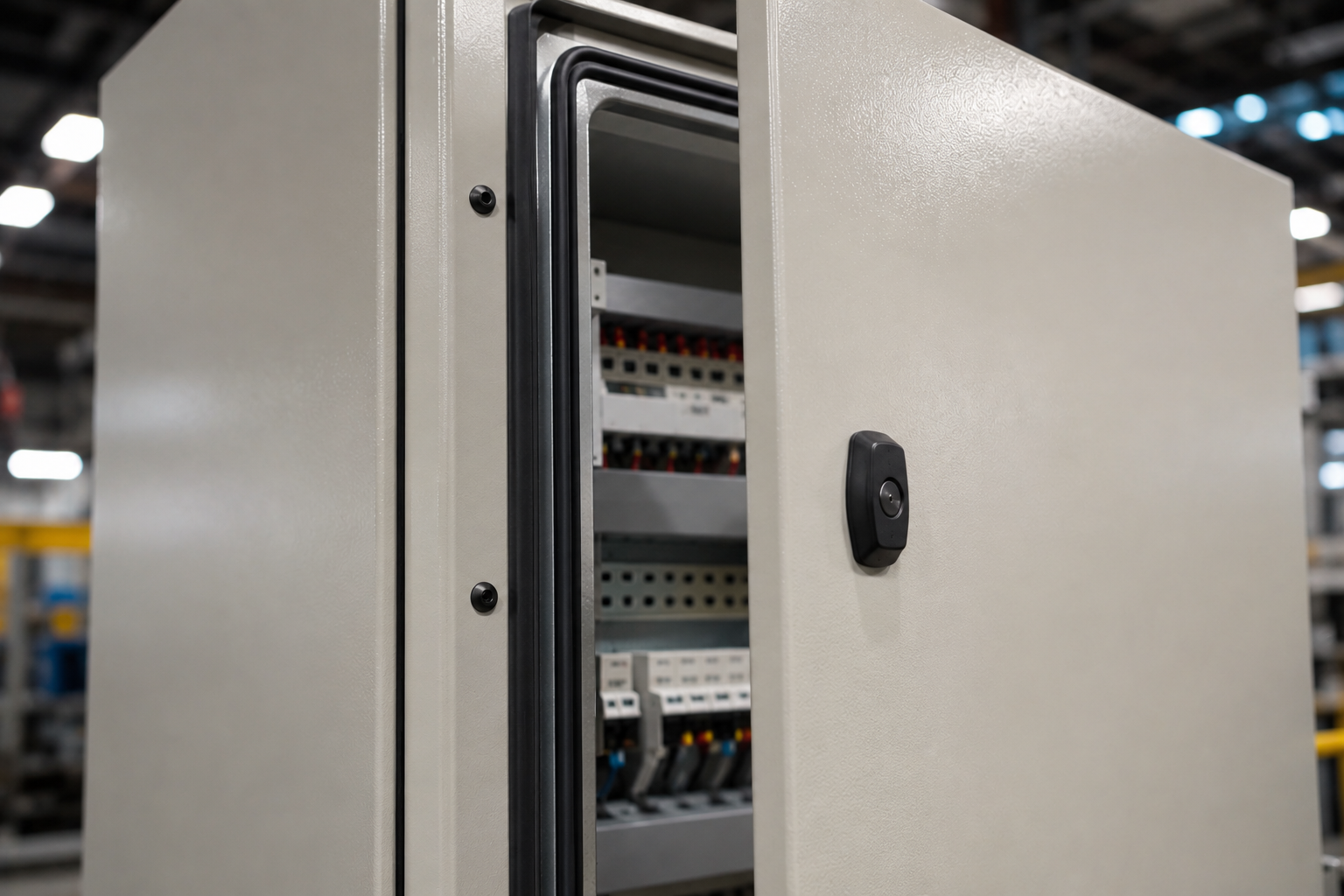
In industrial electrical infrastructure, most attention goes to busbars, breakers, PLCs, cooling systems, and power distribution architecture. Yet one of the most overlooked engineering details — panel door alignment — quietly determines the reliability, safety, and lifespan of the entire enclosure system.
A poorly aligned panel door is not just a cosmetic issue. It can lead to gasket failure, dust ingress, vibration damage, thermal inefficiency, compromised IP ratings, and even premature equipment breakdown. Whether in data centers, renewable energy plants, process industries, telecom shelters, or utility substations, enclosure door precision directly affects operational continuity.
Modern electrical panels are expected to perform in harsh environments involving heat cycles, mechanical stress, transportation vibration, humidity, and continuous operational access. Behind every properly functioning enclosure lies a deep layer of engineering focused on frame rigidity, hinge load balancing, gasket compression consistency, and long-term vibration resistance.
This is the hidden engineering behind panel door alignment.
Why Panel Door Alignment Is More Important Than Most Engineers Realize
Industrial enclosures are designed to protect sensitive electrical and electronic systems from environmental exposure. Maintaining the enclosure’s ingress protection (IP) rating depends heavily on how accurately the door seals against the frame.
Even a small deviation in door geometry can create:
• Uneven gasket pressure
• Air leakage
• Dust ingress
• Water penetration
• Locking stress
• Hinge fatigue
• Structural distortion over time
In high-performance environments such as hyperscale data centers, offshore installations, and renewable energy systems, enclosure tolerances become mission-critical.
For example, operators like Siemens, Schneider Electric, and ABB invest heavily in enclosure rigidity and sealing consistency because electrical reliability depends on it.
The Four Hidden Engineering Factors Behind Panel Door Alignment
1. Frame Warping: The Silent Structural Killer
The enclosure frame acts as the backbone of the electrical panel. If the frame loses dimensional accuracy, the door can never align correctly.
What Causes Frame Warping?
Frame warping typically occurs due to:
• Uneven welding heat
• Poor sheet metal stress management
• Thin structural sections
• Transportation stress
• Improper powder coating bake cycles
• Thermal expansion and contraction
• Heavy component mounting
When large panels are fabricated without controlled welding sequences, residual stress accumulates inside the metal. Over time, this causes slight deformation that shifts hinge geometry and sealing alignment.
Real-World Example
Large industrial OEMs such as Rittal use precision robotic welding and reinforced frame systems specifically to minimize torsional distortion in large enclosures used for automation and data center infrastructure.
Similarly, hyperscale data center operators such as Equinix require high dimensional consistency in electrical infrastructure because cooling efficiency and environmental isolation are critical.
Engineering Solution
To reduce frame warping, manufacturers typically use:
• Reinforced folded profiles
• Controlled welding sequences
• CNC precision fabrication
• Stress-relieved steel structures
• Multi-point structural support
• Thicker gauge materials for larger doors
The goal is to maintain geometric stability throughout the enclosure lifecycle.
2. Hinge Loading and Door Weight Distribution
As enclosure sizes increase, door weight becomes a major engineering challenge.
Modern industrial panels often contain:
• HMIs
• Mimic displays
• Cooling units
• Access control hardware
• Internal wiring ducts
• Monitoring equipment
All of this adds weight to the door structure.
Why Hinge Engineering Matters
Improper hinge placement or undersized hinges create uneven loading, which eventually causes:
• Door sagging
• Misalignment
• Locking difficulty
• Seal inconsistency
• Metal fatigue around hinge points
In outdoor applications or vibration-heavy environments, the problem becomes significantly worse.
Real-Life Example
Eaton and Legrand design industrial enclosures with reinforced hinge assemblies and multi-point locking systems to maintain long-term alignment under repetitive operational use.
In telecom and renewable installations, enclosure doors may be opened thousands of times over their lifespan. Poor hinge engineering accelerates failure.
Understanding Hinge Fatigue
Hinge fatigue develops gradually.
At first, operators notice:
• Slight resistance while closing
• Uneven locking pressure
• Small gaps near corners
Later, the enclosure begins losing sealing consistency.
Eventually:
• Gaskets fail
• Moisture enters
• Internal corrosion develops
• Electrical reliability decreases
This entire failure chain often begins with a few millimeters of hinge misalignment.
3. Gasket Compression Consistency: The Core of IP Protection
One of the biggest hidden engineering challenges is maintaining uniform gasket compression across the entire door perimeter.
The gasket is responsible for:
• Dust protection
• Water resistance
• Thermal sealing
• Pressure balancing
However, gaskets only perform properly when compression is evenly distributed.
What Happens with Uneven Compression?
Over-Compression
Excessive pressure damages the gasket material and causes:
• Permanent deformation
• Reduced elasticity
• Faster aging
• Cracking
Under-Compression
Insufficient pressure creates leakage paths that allow:
• Dust ingress
• Humidity
• Corrosive particles
• Water penetration
In environments like coastal industries, renewable energy farms, or cement plants, even minor leakage can severely affect electrical systems.
Comparison Table: Proper vs Poor Panel Door Alignment
|
Premium enclosure manufacturers often perform compression mapping tests to verify gasket pressure consistency.
Companies like nVent HOFFMAN use advanced sealing validation methods to ensure enclosure performance under industrial conditions.
These tests help verify:
• Uniform sealing pressure
• Door flatness
• Locking consistency
• Environmental reliability
This level of engineering is particularly important in:
• Data centers
• Oil & gas facilities
• Railway infrastructure
• Smart grid systems
• Battery energy storage systems (BESS)
4. Vibration Fatigue: The Long-Term Reliability Challenge
Vibration is one of the most underestimated threats to enclosure integrity.
Industrial environments continuously expose electrical panels to:
• Transformer vibrations
• Generator harmonics
• Compressor movement
• Mechanical equipment resonance
• Transportation shocks
• Wind-induced oscillation
Over time, these micro-vibrations loosen hardware and distort alignment.
How Vibration Affects Door Alignment
Repeated vibration cycles gradually create:
• Fastener loosening
• Hinge displacement
• Locking misalignment
• Metal fatigue
• Seal degradation
This is especially dangerous in:
• Railway systems
• Offshore platforms
• Solar power plants
• Wind farms
• Industrial automation facilities
Real-World Industrial Example
In renewable energy projects, companies such as Tesla and Hitachi Energy deploy outdoor electrical systems exposed to severe environmental and vibration conditions.
These installations require robust enclosure engineering to maintain long-term sealing performance despite transportation stress and field vibration.
Similarly, telecom infrastructure providers use vibration-tested outdoor cabinets because even small seal failures can damage critical communication electronics.
Why Precision Manufacturing Matters More Than Ever
As electrical infrastructure becomes smarter and denser, enclosure tolerances become tighter.
Today’s panels must support:
• Higher heat densities
• Advanced electronics
• Smart monitoring
• Remote diagnostics
• Harsh outdoor deployment
• Long operational cycles
This means panel door alignment is no longer just a fabrication issue — it is a reliability engineering requirement.
Modern Engineering Methods Used to Improve Door Alignment
Advanced enclosure manufacturers now use:
The Cost of Ignoring Panel Door Engineering
Many enclosure failures initially appear unrelated to door alignment.
However, root cause analysis often traces failures back to:
• Poor sealing
• Structural distortion
• Hinge fatigue
• Vibration-induced loosening
The hidden costs include:
• Increased maintenance
• Equipment downtime
• Corrosion damage
• Thermal inefficiency
• Reduced electrical reliability
• Premature enclosure replacement
For mission-critical industries, these failures can become extremely expensive.
Final Thoughts
Panel door alignment may seem like a minor fabrication detail, but in reality, it represents a complex intersection of structural engineering, sealing science, vibration management, and long-term reliability design.
A well-engineered enclosure is not judged only by its appearance or sheet metal thickness. Its real quality lies in how consistently the door maintains alignment after years of operation, environmental exposure, transportation stress, and repetitive use.
As industries move toward smarter infrastructure, higher reliability expectations, and harsher deployment environments, the engineering behind panel door alignment becomes increasingly critical.
Because in industrial electrical systems, reliability is often determined not by the largest component — but by the smallest misalignment.
FAQs
1. Why is panel door alignment important in electrical enclosures?
Proper panel door alignment ensures consistent gasket compression, maintains IP protection, reduces vibration damage, and improves overall enclosure reliability.
2. What causes electrical panel doors to become misaligned?
Common causes include frame warping, hinge fatigue, transportation stress, improper installation, thermal expansion, and long-term industrial vibration.
3. How does poor door alignment affect IP ratings?
Misalignment creates uneven gasket pressure, allowing dust, moisture, and contaminants to enter the enclosure, which compromises the enclosure’s IP protection level.
4. What industries require highly precise enclosure door alignment?
Industries such as data centers, renewable energy, oil & gas, telecom, railways, utilities, and industrial automation require high-precision enclosure engineering.
5. How can manufacturers improve long-term door alignment reliability?
Manufacturers improve reliability using reinforced frames, CNC fabrication, robotic welding, multi-point locking systems, vibration testing, and precision hinge engineering.