As AI workloads, HPC clusters, and next-generation data centers push rack densities beyond 30–100+ kW, traditional air cooling is approaching its practical limits. Liquid cooling has become the preferred solution—but many professionals still use RDHx and CDU interchangeably.
They are not the same thing.
One removes heat from the servers.
The other enables the entire cooling ecosystem to function.
Understanding how they work together is essential when designing high-density IT infrastructure.
A conventional server room relies on Computer Room Air Conditioning (CRAC) units and raised-floor airflow.
This works well for low to medium density deployments.
However, AI GPUs, accelerated computing, and HPC applications generate heat concentrations that air simply cannot remove efficiently.
This is where liquid cooling changes the game.
Instead of cooling the room first, heat is removed directly at—or very close to—the source.
The two key components enabling this are:
Although closely related, they perform completely different functions.
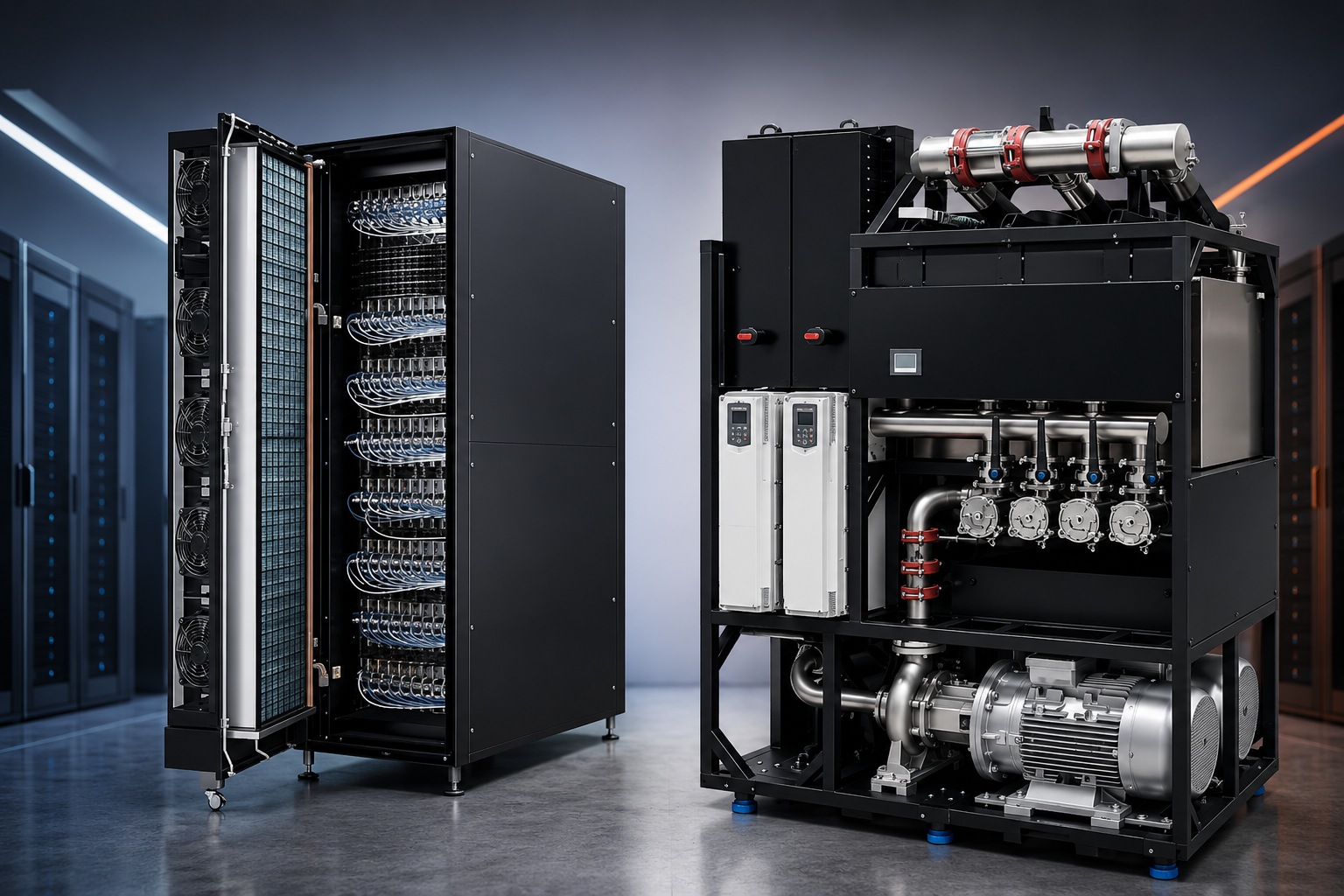
A Rear Door Heat Exchanger (RDHx) is mounted on the rear of an IT rack.
Instead of allowing hot exhaust air to enter the data hall, it passes through a chilled-water heat exchanger integrated into the rear door.
The hot air transfers its heat into the water, and the cooled air exits back into the room.
Server → Hot Air → RDHx → Heat Removed → Cool Air Returned
RDHx is often the preferred first step toward liquid cooling because it requires minimal changes to existing IT equipment.
A Coolant Distribution Unit (CDU) is the hydraulic control center of a liquid cooling system.
Rather than cooling servers directly, it manages the coolant circulating through RDHx units or direct liquid cooling loops.
A CDU typically:
Think of the CDU as the heart that keeps coolant flowing throughout the cooling infrastructure.
Without a CDU, liquid cooling cannot operate reliably.
| Feature | RDHx | CDU |
|---|---|---|
| Primary Function | Removes heat from server exhaust air | Manages coolant circulation |
| Installed At | Rear of the rack | Mechanical room or row-level |
| Uses Water? | Yes | Yes |
| Directly Cools Servers? | Indirectly | No |
| Controls Flow & Pressure | No | Yes |
| Required for Liquid Cooling | Often | Almost Always |
The easiest way to understand the relationship is to follow the heat.
Step 1
Servers generate hot exhaust air.
↓
Step 2
The RDHx absorbs this heat using chilled water.
↓
Step 3
The warmed coolant returns to the CDU.
↓
Step 4
The CDU regulates temperature, pressure, and flow before sending cooled liquid back to the RDHx.
↓
Step 5
The cycle repeats continuously.
The RDHx removes heat.
The CDU keeps the cooling loop operating safely and efficiently.
Only in very limited facility designs where building chilled water can directly supply the RDHx.
Most modern high-density deployments still use a CDU for better hydraulic control, isolation, and reliability.
Absolutely.
CDUs are also used with:
The CDU is cooling-technology agnostic—it simply manages coolant delivery.
This is the wrong question.
In most enterprise AI deployments, it's not RDHx or CDU—it’s RDHx and CDU.
Each addresses a different engineering challenge:
Together, they create a scalable cooling infrastructure capable of supporting today's high-density compute environments while preparing for tomorrow's even greater thermal demands.
As rack power continues climbing toward 100–150 kW and beyond, liquid cooling is becoming standard rather than optional.
Organizations planning AI factories, hyperscale facilities, or HPC clusters should evaluate cooling systems as an integrated ecosystem—not as individual products.
Selecting the right combination of RDHx, CDU, piping, controls, and monitoring can significantly improve:
Cooling is no longer just facility infrastructure—it has become a strategic enabler of compute performance.
High-density computing demands more than simply adding chilled water to the data center.
It requires a coordinated cooling architecture where every component has a defined role.
The Rear Door Heat Exchanger (RDHx) removes the heat generated by IT equipment.
The Coolant Distribution Unit (CDU) ensures that heat can be transported away efficiently, safely, and continuously.
Understanding the distinction between the two helps data center designers, operators, and infrastructure teams build cooling systems that are ready for the next generation of AI and high-performance computing.
An RDHx (Rear Door Heat Exchanger) removes heat from server exhaust air, while a CDU (Coolant Distribution Unit) manages the circulation, temperature, and pressure of the cooling liquid.
In some low-complexity installations, yes. However, most high-density data centers use a CDU to provide stable coolant flow, hydraulic isolation, and better system control.
No. A CDU does not remove heat from servers. It distributes and regulates coolant to devices such as RDHx units or Direct-to-Chip cooling systems.
For high-density AI and HPC environments, RDHx and CDU work together. The RDHx removes rack heat, while the CDU ensures efficient and reliable coolant delivery.
When rack power densities exceed 30–40 kW, liquid cooling solutions like RDHx and CDU become increasingly effective for improving cooling efficiency, reducing energy consumption, and supporting future scalability.