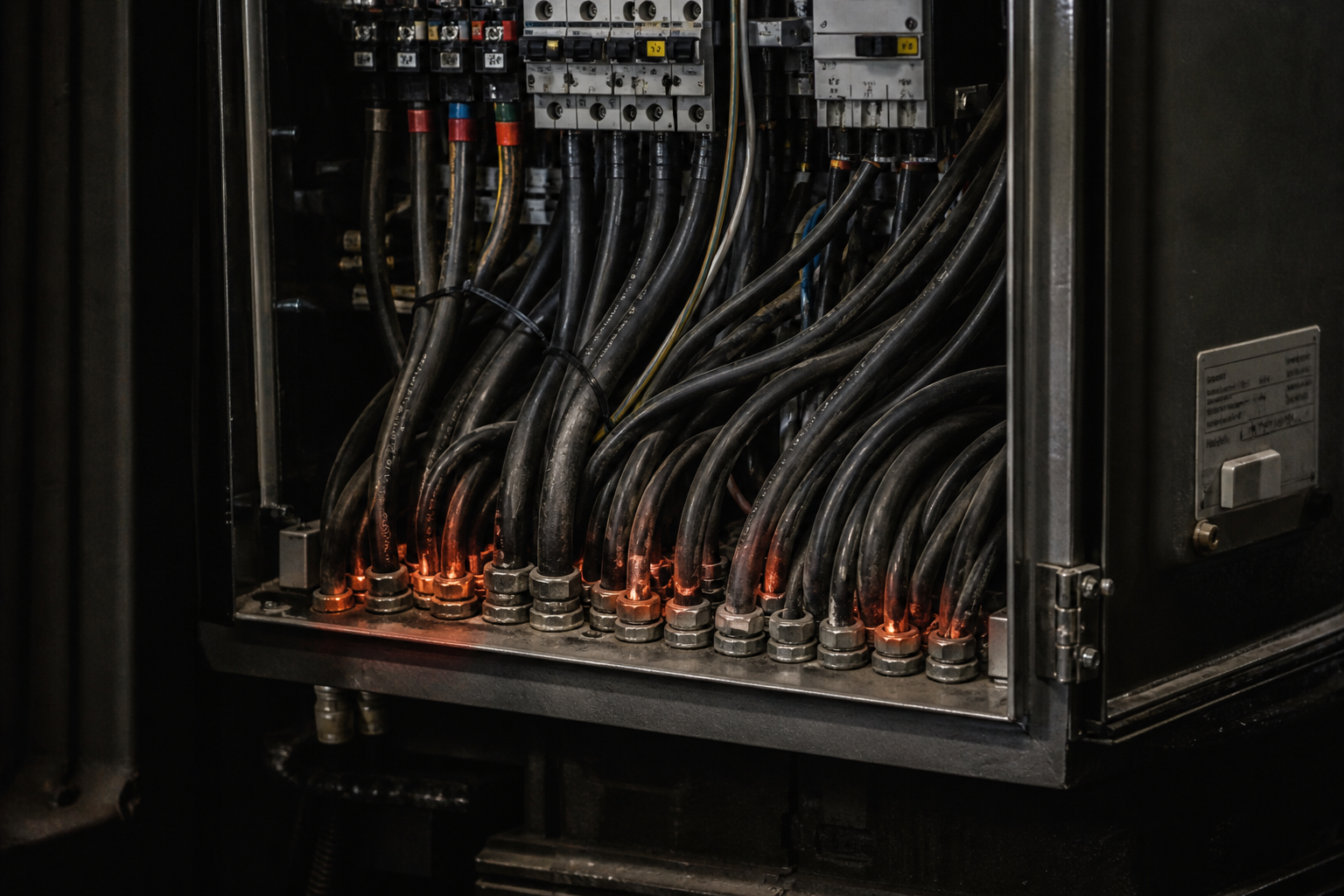
In modern electrical infrastructure—especially across data centers, renewable plants, EV charging hubs, and industrial automation systems—panel design is evolving rapidly. Cable volumes are increasing, power densities are rising, and system complexity is growing. However, one component often remains outdated in many designs: the standard gland plate.
What appears to be a simple sheet metal interface at the bottom of a panel is, in reality, one of the most critical and overlooked failure points.
This article explores why standard gland plates fail in high cable density environments and how this design limitation can lead to thermal issues, sealing failures, and long-term reliability risks.
The Real Problem: Designed for Lower Cable Loads
Traditional gland plates were designed for a different era, when:
Today’s reality is very different:
The result is overcrowded gland plates attempting to perform beyond their intended capacity.
Mechanical Stress: A Hidden Reliability Risk
When a large number of cables pass through a flat gland plate, several mechanical issues arise:
Real-World Example
In a large-scale data center deployment in India, EPC contractors reported repeated insulation wear near gland entry zones in high-density LV panels. Investigation revealed:
Over time, these factors led to insulation degradation, cable joint failures, and increased maintenance cycles.
In such cases, the gland plate effectively becomes a mechanical stress concentration point.
Heat Trapping: A Thermal Bottleneck
High cable density leads to higher current flow and increased heat generation. Standard gland plates:
Industry Insight
Thermal imaging studies in lithium-ion BESS installations have shown hotspots near cable entry zones exceeding panel internal averages by 8–12°C. This is primarily due to compact gland arrangements and poor heat dissipation.
This issue is particularly critical in:
Heat buildup affects not only cables but also overall panel performance, component lifespan, and safety margins.
Sealing Inefficiency: Compromised IP Performance
Maintaining ingress protection becomes difficult with standard gland plates when:
Real-World Example
In coastal solar installations in western and southern India, operators have reported moisture ingress through gland plates during monsoon conditions. This resulted in:
Even when high IP-rated enclosures are used, the weakest point is often the gland interface rather than the enclosure itself.
Installation Complexity and Human Error
As cable density increases, so does installation complexity. Standard gland plates require:
This increases the likelihood of:
In large-scale projects, these inefficiencies can significantly impact cost and execution schedules.
Comparison: Standard vs Optimized Cable Entry Systems
|
Feature |
Standard Gland Plate |
High-Density Optimized Entry System |
|
Cable Capacity |
Limited |
High with modular expansion |
|
Mechanical Stress |
High due to congestion |
Reduced through structured routing |
|
Heat Dissipation |
Poor |
Improved with spacing and airflow |
|
Sealing Efficiency |
Inconsistent |
Engineered, reliable sealing |
|
Installation Time |
Higher |
Faster with modular systems |
|
Flexibility |
Low |
High adaptability |
|
Maintenance |
Difficult |
Easier access and segregation |
Industry Shift: Moving Beyond Standard Gland Plates
Leading infrastructure developers are adopting improved cable entry strategies, including:
Hyperscale data center operators are increasingly using prefabricated power modules with optimized cable entry designs. Similarly, renewable energy EPCs are shifting toward containerized systems with engineered entry interfaces.
The industry trend clearly indicates a transition away from traditional gland plates in high-performance applications.
Design Alternatives for High-Density Applications
For systems with high cable density, the following approaches are more effective:
Why This Matters
With increasing emphasis on:
Cable entry design is no longer a minor detail. It is a critical engineering consideration that directly impacts system reliability and lifecycle performance.
Ignoring gland plate limitations can lead to:
Learn more about advanced panel design and cable management solutions at:
https://www.brickandbyte.in
FAQs
1. Why are standard gland plates unsuitable for high cable density panels?
They are not designed to handle large volumes of cables, leading to congestion, heat buildup, and sealing issues.
2. What is the primary risk of overcrowded gland plates?
Mechanical stress and thermal accumulation, which can damage cables and reduce system reliability.
3. How do gland plates affect IP ratings?
Improper sealing, unused openings, and mismatched glands can compromise ingress protection.
4. Are modular cable entry systems more efficient?
Yes, they improve installation speed, enhance reliability, and reduce long-term maintenance requirements.
5. Where are advanced cable entry systems most critical?
They are essential in data centers, BESS installations, EV infrastructure, and high-load industrial panels.