Introduction: Reliability Doesn’t Start at Commissioning
In the electrical infrastructure industry, most conversations around reliability begin at installation, testing, or commissioning. But in reality, some of the most critical failures are already “designed in” long before a panel is energized.
Between factory dispatch and site installation lies a phase that is rarely engineered with the same rigor: transportation and handling.
This is where perfectly manufactured panels—tested, inspected, and compliant—quietly accumulate micro-damage that later manifests as overheating, insulation breakdown, or mechanical failure.
If you’ve ever seen a panel fail within months despite meeting all standards, chances are the root cause didn’t start in operation—it started in transit.
What Really Happens During Transportation?
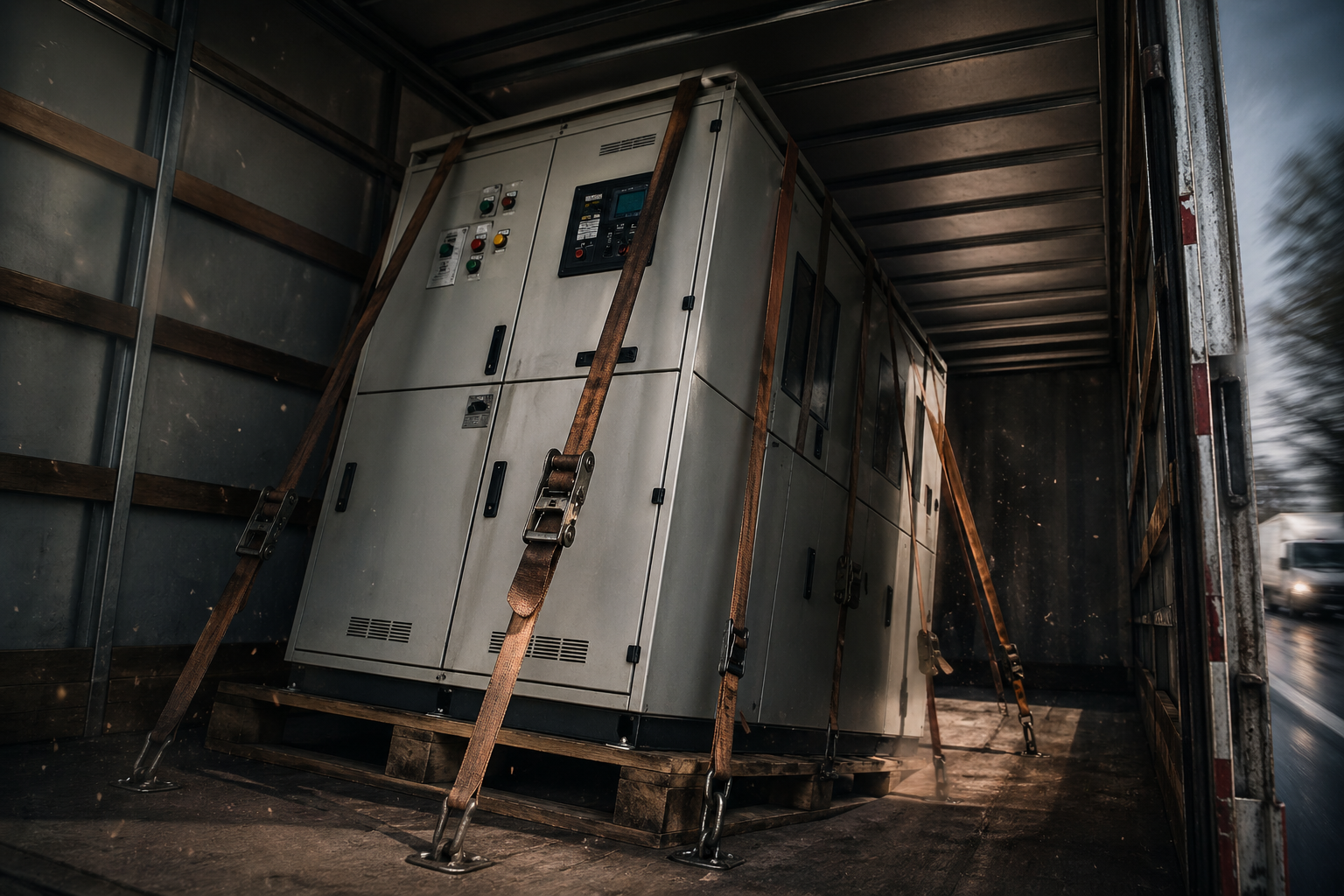
Electrical panels—especially LV/MV switchboards, control panels, and enclosures—are subjected to multiple uncontrolled stress factors during logistics:
Continuous vibration (road/rail transport)
Shock loads (loading/unloading impacts)
Tilting and improper stacking
Temperature and humidity variations
Packaging failures or poor load securing
Unlike factory conditions, transport environments are dynamic and unpredictable.
Even when damage is not visibly apparent, internal components may experience:
Micro-cracks in insulation materials
Loosening of bolted joints
Misalignment of busbars
Hairline fractures in copper or aluminum conductors
Stress concentration on cable terminations
These are not immediate failures—they are latent defects.
The Three Silent Failure Mechanisms
1. Micro-Cracks in Insulation
Insulation materials like epoxy, heat-shrink sleeves, or molded barriers are rigid by nature. Under repeated vibration:
They develop micro-fractures
Dielectric strength gradually reduces
Moisture ingress becomes easier
Over time, this leads to:
Partial discharge
Tracking
Eventual insulation breakdown
2. Mechanical Misalignment
Panels are designed with tight tolerances. However:
Transport shocks can shift busbars by a few millimeters
Mounting supports may deform slightly
Alignment between moving and fixed contacts can be affected
Even small misalignments can result in:
Uneven current distribution
Increased contact resistance
Localized heating
3. Stress on Electrical Connections
Every bolted joint, lug, and termination is a potential weak point.
During transit:
Vibrations loosen fasteners
Spring washers lose preload effectiveness
Cable lugs experience pull and torsion stress
This leads to:
Increased resistance at joints
Hotspots during operation
Accelerated aging
Real-World Example: When Transit Costs Millions
A well-documented case involved a large data center project in Asia where switchgear supplied by a global OEM (similar to companies like Siemens or Schneider Electric) faced early-stage failures.
What Happened:
Panels passed factory acceptance tests (FAT)
Transported over ~1,500 km via road
Installed without detailed incoming inspection
Within 6 Months:
Multiple feeders showed overheating
Infrared scans detected hotspots at busbar joints
Insulation resistance dropped in certain sections
Root Cause Analysis:
Transport-induced vibration loosened critical bolted joints
Minor misalignment increased stress on insulation barriers
No re-torqueing or alignment checks were done post-delivery
Outcome:
Partial shutdown of systems
Replacement of multiple sections
Project delays and reputational damage
The panels were not “defective”—they were damaged in transit.
Transportation vs Installation: Where Damage Really Starts
|
Parameter |
During Manufacturing |
During Transportation |
During Installation |
|
Environment Control |
Highly controlled |
Uncontrolled |
Semi-controlled |
|
Mechanical Stress |
Minimal |
High vibration & shock |
Moderate |
|
Inspection Level |
100% tested |
Rarely inspected |
Visual checks mostly |
|
Risk of Hidden Damage |
Low |
Very High |
Medium |
|
Accountability |
Manufacturer |
Often unclear |
Contractor |
Key Insight:
Transportation is the least controlled but highest risk phase—yet it receives the least attention.
Why This Problem Is Underestimated
1. Damage Is Not Visible
Unlike dents or scratches, electrical damage:
Happens internally
Shows up only under load
Often delayed
2. Responsibility Is Fragmented
Manufacturer blames logistics
Logistics blames packaging
Site blames manufacturer
Result: No one owns the problem end-to-end
3. Lack of Standardized Handling Protocols
While standards like IEC focus on design and testing, transportation practices are often left to interpretation.
Critical Risk Zones in Panels
Certain components are more vulnerable during handling:
Busbar systems (especially long unsupported spans)
Breaker mounting structures
Cable entry and termination zones
Relay and control wiring compartments
Insulated barriers and shrouds
These areas should be treated as high-sensitivity zones during logistics.
Engineering for Transport: What Should Be Done
1. Transport-Oriented Design
Panels should not just be designed for operation—but for movement.
Reinforced structural frames
Vibration-resistant mounting
Flexible supports for busbars
Shock-absorbing base designs
2. Smart Packaging Matters
Typical wooden crates are not enough.
Best practices include:
Anti-vibration mounts
Foam isolation layers
Moisture barrier wrapping
Tilt and shock indicators
3. Pre-Dispatch Simulation
Advanced manufacturers simulate:
Vibration profiles
Shock loads
Transport conditions
This is common in industries like aerospace—but underutilized in electrical systems.
4. Post-Delivery Protocols (Most Ignored Step)
Every panel should undergo:
Torque verification of all joints
Insulation resistance testing
Alignment checks
Functional re-validation
Skipping this step is one of the biggest risks in the industry.
The Cost of Ignoring Transportation Damage
Ignoring this phase doesn’t just risk failure—it compounds costs:
Unplanned downtime
Fire hazards due to hotspots
Reduced equipment lifespan
Warranty disputes
Brand reputation loss
For critical infrastructure like:
Data centers
Renewable plants
Industrial facilities
Even a minor failure can escalate into multi-crore losses.
Industry Shift: From Manufacturing Quality to Lifecycle Reliability
Forward-thinking companies are shifting focus from:
“Did we build it right?” → “Will it survive the journey and operate reliably?”
This includes:
End-to-end responsibility
Integrated logistics planning
On-site validation support
Companies like ABB and Eaton have increasingly emphasized lifecycle reliability—not just product compliance.
Practical Checklist for Buyers & EPC Contractors
Before accepting any panel on site:
Check for transport damage indicators
Perform torque checks on critical joints
Conduct insulation resistance testing
Verify busbar alignment
Inspect mounting rigidity
If these steps are skipped, you are essentially energizing an unverified system.
Conclusion: The Failure You Don’t See Is the One That Hurts Most
Panel failures rarely happen because of a single catastrophic event.
They build up silently:
A slightly loose joint
A barely visible crack
A small misalignment
And most of these originate not in design or operation—but in transportation and handling.
The industry needs to recognize this phase not as logistics—but as a critical engineering stage.
Because by the time a panel is installed,
its future reliability may already be compromised.
FAQs
1. Why is panel transportation considered high risk?
Because panels face uncontrolled vibration, shock, and environmental conditions that can cause internal, invisible damage.
2. What are the most common hidden damages during transit?
Micro-cracks in insulation, loose electrical connections, and busbar misalignment.
3. Can transportation damage be detected before operation?
Yes—through torque checks, insulation resistance testing, and detailed inspection protocols.
4. Who is responsible for transit-related damage?
Responsibility is often unclear, which is why end-to-end ownership or strict inspection protocols are essential.
5. How can companies prevent such failures?
By designing for transport, improving packaging, simulating logistics stress, and performing mandatory post-delivery checks.