In modern electrical systems—whether it’s data centers, renewable energy plants, industrial facilities, or utility-grade switchgear—the busbar system plays a critical role in power distribution. But one often overlooked design decision can significantly impact performance, maintenance, and long-term reliability:
Should you use bolted busbars or welded busbars?
This isn’t just a fabrication choice—it’s a strategic engineering decision that affects thermal performance, fault tolerance, scalability, and lifecycle cost.
In this blog, we break down bolted vs welded busbars, compare their strengths and limitations, and help you choose the right approach for your application.
What Are Busbars and Why Do Connections Matter?
Busbars are metallic conductors—typically made of copper or aluminum—used to distribute electrical power efficiently within switchboards, panel boards, substations, and energy storage systems.
While busbar sizing and material selection are critical, the connection method between busbars is equally important because it directly affects:
Electrical conductivity
Heat dissipation
Mechanical strength
Ease of installation and maintenance
Fault performance
Two primary connection methods dominate the industry:
Bolted Busbar Connections
Welded Busbar Connections
Bolted Busbars: Flexible and Field-Friendly
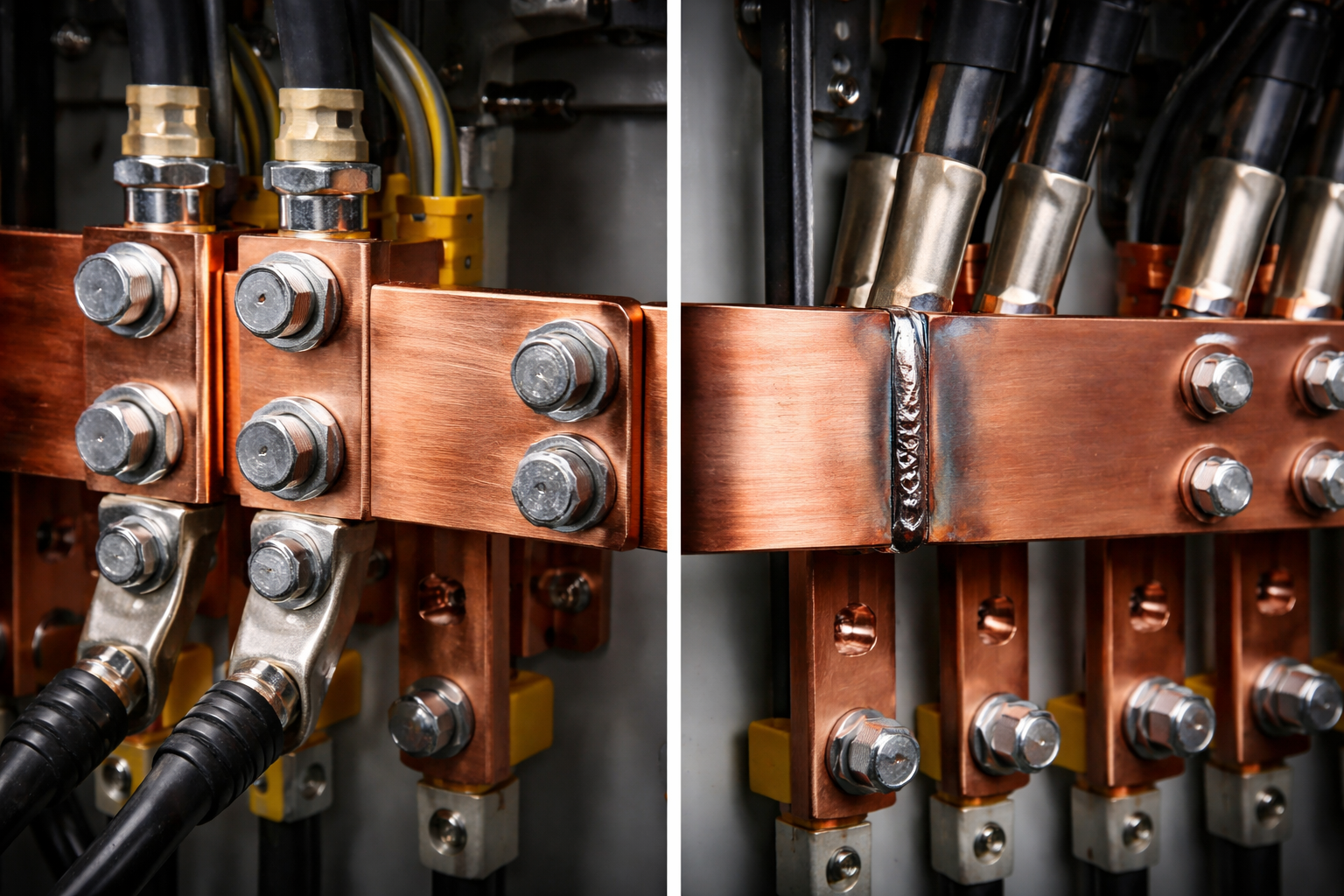
Bolted connections involve joining busbars using nuts, bolts, washers, and contact surfaces, often with plating (tin/silver) to improve conductivity and prevent oxidation.
Key Advantages
1. Easy Installation & Maintenance
Bolted busbars can be assembled, disassembled, and modified easily—ideal for projects requiring future expansion or maintenance access.
2. Scalability
Perfect for modular systems like:
LV/MV switchboards
Data center power distribution
Battery Energy Storage Systems (BESS)
3. No Heat-Affected Zones (HAZ)
Unlike welding, bolting does not alter the material structure, preserving the original conductivity and strength.
4. Field Assembly Capability
Bolted joints can be installed on-site, reducing dependence on factory fabrication.
Limitations
Requires proper torqueing to avoid loose connections
Higher risk of contact resistance if surfaces are not clean or aligned
Periodic inspection may be needed in high-vibration environments
Welded Busbars: Permanent and Compact
Welded busbars involve joining conductors using techniques like TIG welding, MIG welding, or brazing, creating a permanent metallic bond.
Key Advantages
1. Low Electrical Resistance
A properly executed weld offers near-continuous conductivity, minimizing losses.
2. Compact Design
No need for bolts or spacing → enables space-saving designs, especially in high-density panels.
3. High Mechanical Strength
Welded joints are rigid and robust, suitable for high fault current environments.
4. Reduced Maintenance
No need for re-tightening or periodic inspection of joints.
Limitations
Not easily modifiable—permanent connection
Heat can affect material properties (annealing, reduced conductivity)
Requires skilled fabrication and quality control
Difficult to repair in case of failure
Bolted vs Welded Busbars: Head-to-Head Comparison
|
Parameter |
Bolted Busbars |
Welded Busbars |
|
Installation |
Easy, field-friendly |
Requires factory setup |
|
Maintenance |
Accessible, re-tightening required |
Minimal maintenance |
|
Flexibility |
Highly modular and scalable |
Rigid, permanent |
|
Electrical Resistance |
Slightly higher (depends on contact) |
Very low (continuous path) |
|
Thermal Performance |
Depends on contact quality |
Generally better |
|
Mechanical Strength |
Good (depends on fastening) |
Very high |
|
Space Requirement |
More (due to hardware) |
Compact design |
|
Cost |
Lower initial fabrication cost |
Higher due to welding process |
|
Failure Risk |
Loose joints possible |
Weld defects possible |
|
Best Use Cases |
Switchboards, BESS, modular systems |
Compact panels, high-current systems |
Application-Based Decision Making
Choosing between bolted and welded busbars depends heavily on your application:
1. Data Centers & Critical Power
Prefer bolted busbars
Reason: Easy upgrades, maintenance access, scalability
2. Battery Energy Storage Systems (BESS)
Bolted connections dominate due to:
Modular battery racks
Frequent reconfiguration
Maintenance requirements
3. Industrial Switchboards (LV/MV Panels)
Mostly bolted
Allows easy replacement and compliance with standards like IEC 61439
4. High Current Compact Panels
Prefer welded busbars
Where space is limited and current density is high
5. Hazardous / Flameproof Applications
Often welded for:
Integrity and sealing reliability
Reduced risk of loose connections
Thermal Performance: The Hidden Factor
One of the most critical yet overlooked aspects is thermal management.
Bolted joints can develop hotspots if not properly torqued
Welded joints distribute current more evenly, reducing localized heating
However, modern engineering practices—like:
Proper surface treatment
Torque-controlled assembly
Use of spring washers
…can make bolted connections equally reliable when designed correctly.
Standards and Compliance
For industries governed by strict standards such as IEC 61439, connection integrity is critical.
Bolted systems are often preferred because:
They are testable and verifiable
Easier to inspect during audits
Welded systems require:
Certified welding procedures
Non-destructive testing (NDT)
Lifecycle Cost Consideration
While welded busbars may seem superior in performance, the total cost of ownership (TCO) tells a different story.
Bolted Busbars
Lower upfront cost
Slightly higher maintenance
Lower downtime cost (easy repair)
Welded Busbars
Higher fabrication cost
Minimal maintenance
High repair/replacement cost if failure occurs
Hybrid Approach: The Best of Both Worlds?
In many advanced electrical systems, engineers are now adopting a hybrid approach:
Welded sections for critical, high-current paths
Bolted interfaces for modular connections and accessibility
This approach balances:
Performance
Flexibility
Maintainability
How Brick & Byte Designs Busbar Systems
At Brick & Byte Innovative Products Ltd., we design and manufacture custom busbar systems tailored to application-specific requirements across:
Data centers
Renewable energy systems
Industrial infrastructure
Battery energy storage systems
Our engineering approach includes:
Detailed thermal and current density analysis
Selection of optimal connection methods (bolted/welded/hybrid)
Compliance with IEC standards
High-precision fabrication and assembly
Explore our solutions:
LV/MV Switchboards & Panels
BESS & Energy Storage Integration
Custom Enclosures & Busbar Chambers
Conclusion: It’s Not About Better—It’s About Right Fit
There is no universal winner in the bolted vs welded busbar debate.
If you need flexibility, scalability, and ease of maintenance → go for bolted busbars
If your priority is compact design, high strength, and minimal resistance → choose welded busbars
The best solution often lies in engineering judgment and application-specific design.
FAQs
1. Which is better: bolted or welded busbars?
Neither is universally better—bolted is ideal for flexibility and maintenance, while welded is best for compact, high-performance systems.
2. Do bolted busbars require maintenance?
Yes, periodic inspection and torque checks are recommended, especially in high-load or vibration environments.
3. Are welded busbars more efficient?
Yes, they typically have lower electrical resistance due to continuous metal contact.
4. Can bolted busbars handle high current?
Absolutely—when properly designed and torqued, they perform reliably even in high-current applications.
5. What is the common choice in modern switchboards?
Bolted busbars are more commonly used due to their modularity, compliance, and ease of maintenance.