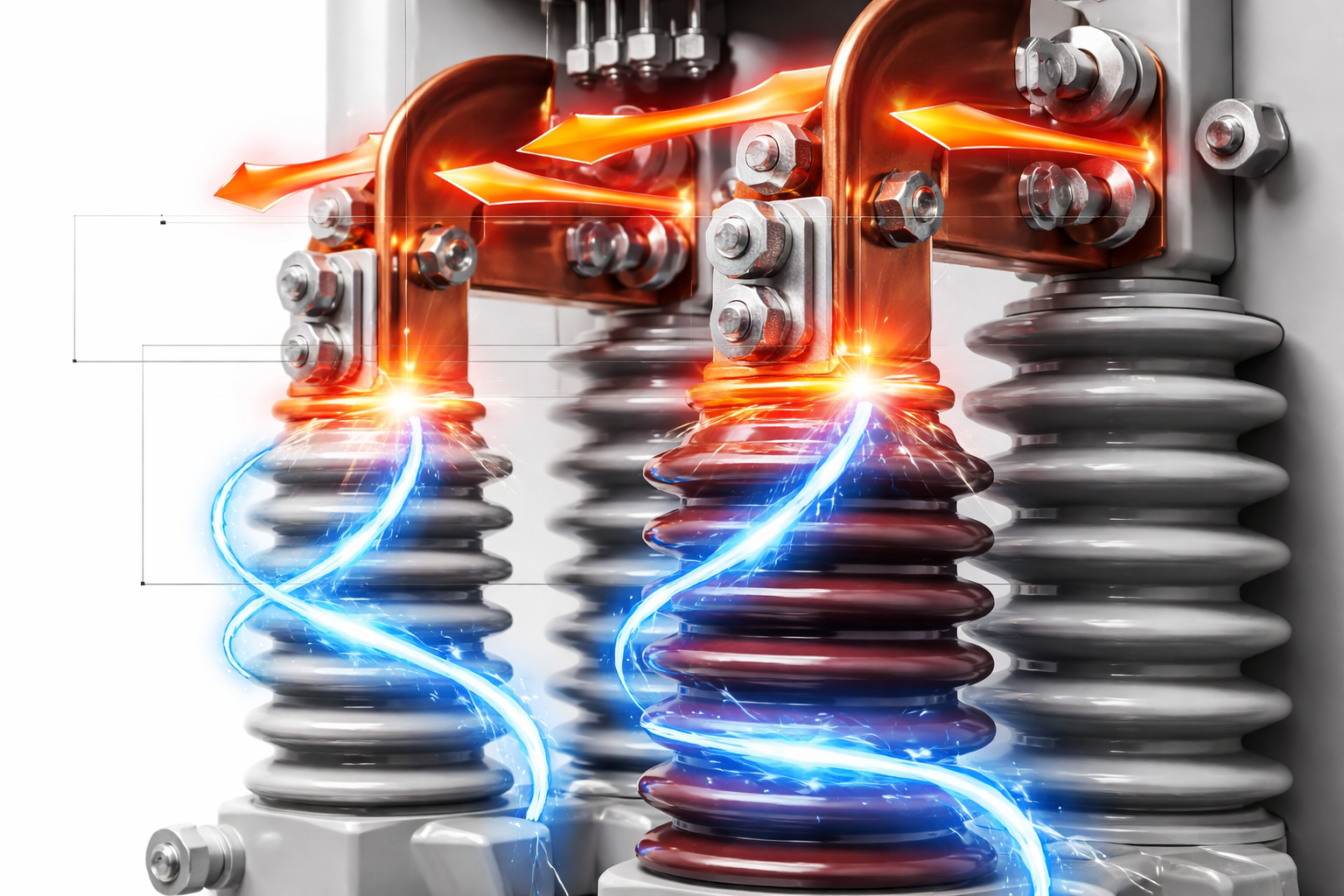
In modern electrical infrastructure—ranging from data centers and renewable energy plants to industrial facilities and rail systems—busbar support insulators play a mission-critical role. Yet, they are often overlooked until failure occurs.
Designing these components is not straightforward. Engineers must balance three competing forces:
Short-circuit mechanical forces
Creepage and clearance requirements
Thermal aging due to load cycles
This creates a complex design conflict that directly impacts switchboard reliability, safety, and lifecycle performance.
In this deep dive blog, we explore the mechanical vs electrical design conflict in busbar insulators, supported by real-world applications, industry practices, and engineering insights.
What Are Busbar Support Insulators?
Busbar support insulators are components used to:
Mechanically support busbars (copper or aluminum conductors)
Electrically isolate them from grounded structures
Maintain phase-to-phase spacing
Withstand environmental and electrical stress
They are widely used in:
LV/MV switchboards
Busduct and busway systems
Transformer connections
Power distribution panels
Without proper insulator design, systems risk:
Flashovers
Short circuits
Arc faults
Equipment damage
Why This Topic Matters
This topic is highly relevant for:
Busbar insulator design
Short circuit withstand in switchgear
Creepage distance in electrical systems
Thermal effects in busbar systems
Electrical panel reliability
These keywords are critical for industries like EPC, panel builders, data centers, utilities, and OEMs.
Mechanical Design: Surviving Short-Circuit Forces
The Physics Behind the Problem
When a short circuit occurs, current can surge up to 20–50 times the rated current. This creates intense electromagnetic forces between busbars.
These forces:
Act instantly (within milliseconds)
Can reach several kilonewtons
Cause bending, vibration, and displacement
Mechanical Requirements for Insulators
To handle this, insulators must provide:
High compressive strength
High flexural strength
Resistance to dynamic shock loads
Design Implications
Support spacing becomes critical (typically 300–500 mm)
Weak supports can lead to busbar collapse or phase contact
Mechanical failure often precedes electrical failure
Electrical Design: Creepage & Clearance Requirements
Understanding Creepage Distance
Creepage distance is the shortest path along the surface of an insulator between two conductive parts.
It is essential because:
Dust, moisture, and chemicals create conductive paths
Surface tracking can lead to insulation failure
Clearance Distance
Clearance is the shortest distance through air between conductors.
Both are defined by standards such as:
IEC 60664
IEC 61439
Key Design Factors
Voltage level
Pollution degree (industrial vs clean environment)
Material CTI (Comparative Tracking Index)
Higher pollution environments demand larger creepage distances, sometimes exceeding 20 mm/kV.
The Core Conflict: Mechanical vs Electrical Design
Designing busbar insulators is a balancing act between strength and insulation performance.
1. Compact Design vs Creepage Distance
Mechanical stability prefers short, compact insulators
Electrical safety requires longer creepage paths
➡ Increasing creepage often reduces mechanical rigidity.
2. Solid Structure vs Ribbed Geometry
Mechanical strength favors solid shapes
Electrical performance requires ribbed surfaces to increase creepage
➡ Ribbing improves insulation but introduces stress concentration points.
3. Support Spacing vs Electrical Clearance
Fewer supports reduce cost and complexity
More supports improve mechanical stability
➡ But additional supports reduce electrical spacing and complicate layout.
Thermal Cycling: The Long-Term Design Challenge
What Happens Over Time?
Busbars heat up under load and cool down during off cycles. This causes:
Expansion and contraction
Mechanical stress on insulators
Material fatigue
Effects on Insulators
Micro-cracks in insulation
Reduced dielectric strength
Loosening of mounting points
Why It Matters
Even a perfectly designed system can fail after years due to thermal aging.
This is especially critical in:
Data centers (variable loads)
Renewable systems (intermittent generation)
Industrial plants (cyclic operations)
Comparison Table: Mechanical vs Electrical Design Trade-Offs
|
Parameter |
Mechanical Design Focus |
Electrical Design Focus |
Resulting Conflict |
|
Objective |
Structural strength |
Insulation reliability |
Competing priorities |
|
Design Shape |
Compact, solid |
Ribbed, extended |
Geometry compromise |
|
Key Stress |
Short-circuit forces |
Voltage & contamination |
Multi-stress design |
|
Material |
High strength composites |
High CTI insulation |
Material trade-off |
|
Support Spacing |
Closer supports |
Larger spacing needed |
Layout complexity |
|
Failure Mode |
Breakage |
Flashover |
Combined failure risk |
Real-World Industry Examples
Siemens – Medium Voltage Switchgear
Focus: Compact design + high fault withstand
Solution: Epoxy-based high-strength insulators + simulation-driven design
Schneider Electric – Low Voltage Panels
Challenge: High current + limited space
Approach: Optimized support spacing + modular busbar systems
ABB – Data Center Busway Systems
Issue: Thermal cycling + continuous operation
Solution: Flexible mounting + thermally stable insulation systems
Eaton – Industrial Applications
Challenge: High pollution environments
Solution: Increased creepage distance + ribbed insulator designs
Engineering Solutions to Resolve the Conflict
1. Advanced Materials
DMC (Dough Molding Compound)
Epoxy composites
High CTI polymers
These provide both:
Mechanical strength
Electrical insulation performance
2. Optimized Rib Design
Multi-rib structures
Increased creepage without increasing height
3. Simulation-Based Engineering
Using FEA tools to:
Predict short-circuit forces
Identify weak points
Optimize support placement
4. Hybrid Mounting Systems
Fixed supports for strength
Sliding/flexible joints for thermal expansion
5. Compliance with Standards
Designing as per:
IEC 61439 (switchgear assemblies)
IEC 60664 (insulation coordination)
Ensures long-term reliability and safety.
Key Takeaways for Engineers & Panel Builders
Busbar insulator design is a multi-disciplinary challenge
Mechanical, electrical, and thermal factors must be considered together
Over-optimizing one parameter leads to failure in another
Real-world reliability depends on balanced engineering design
Conclusion
Busbar support insulators are not just passive components—they are critical reliability enablers in power systems.
The conflict between:
Short-circuit mechanical forces
Creepage and clearance requirements
Thermal aging
…makes their design one of the most complex aspects of electrical engineering.
The best systems don’t choose between mechanical and electrical priorities—they integrate both intelligently.
FAQs
1. What is a busbar support insulator?
It is a component that provides mechanical support and electrical insulation for busbars in power distribution systems.
2. Why is creepage distance important?
It prevents surface tracking and electrical failure, especially in polluted or humid environments.
3. What happens during a short circuit in busbars?
Massive currents generate electromagnetic forces that can deform busbars and damage supports.
4. Which material is best for busbar insulators?
Epoxy and DMC materials are widely used due to their high strength and excellent insulation properties.
5. How does thermal cycling affect busbar systems?
Repeated heating and cooling cause material fatigue, cracks, and eventual insulation failure.