
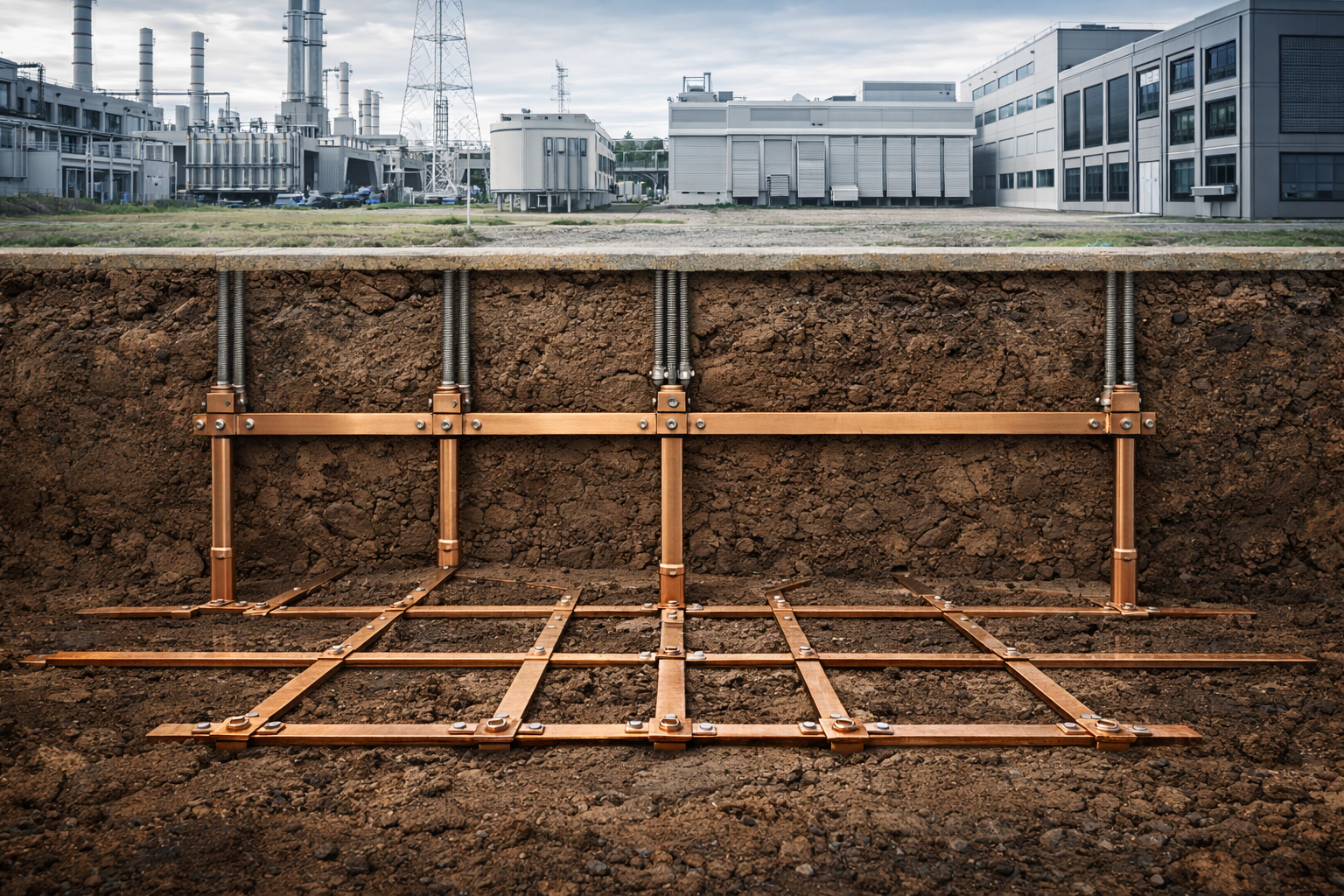
When earthing (grounding) is mentioned in electrical design meetings, it is usually treated as a checkbox item for safety compliance—something required by standards, inspectors, and insurance auditors. But in modern facilities filled with PLCs, VFDs, data centers, instrumentation, and sensitive electronics, earthing plays a far bigger role.
Poor earthing doesn’t just shock people—it silently destroys reliability.
From random PLC faults to unexplained VFD trips and data corruption, grounding issues are often the invisible root cause.
This article explores how earthing directly impacts system reliability, why it’s often overlooked, and how global companies learned the hard way that grounding is not optional engineering—it’s foundational infrastructure.
Earthing: More Than a Safety Measure
Traditionally, earthing has been associated with:
While all of this is true, modern electrical systems demand much more.
Today’s facilities rely on:
These systems require stable reference potentials. Without proper earthing, voltages float, noise increases, and reliability collapses.
In short: Safety earthing protects people.
Functional earthing protects systems.
How Poor Earthing Actually Affects System Reliability
1. Electronics Hate Floating Grounds
Modern electronics—PLCs, HMIs, servers, UPS systems—are designed to operate with a clean, stable ground reference.
When earthing is poor:
This leads to:
These failures are often misdiagnosed as software bugs or defective hardware, when the real issue lies beneath the floor—in the earthing grid.
2. VFDs and Drives Become Noise Generators
Variable Frequency Drives (VFDs) are notorious for generating:
With improper earthing:
Result:
Many “VFD problems” are actually earthing problems in disguise.
3. Instrumentation Loses Accuracy and Trust
In industries like oil & gas, pharmaceuticals, power, and manufacturing, instrumentation accuracy is everything.
Poor earthing causes:
Operators lose trust in data, leading to:
A ₹500 earthing oversight can compromise a ₹5 crore automation system.
Comparison Table: Good vs Poor Earthing
|
Parameter |
Proper Earthing System |
Poor / Inadequate Earthing |
|
PLC stability |
Stable operation, no random faults |
Intermittent CPU resets, false I/O |
|
VFD performance |
Smooth operation, minimal EMI |
Frequent trips, noise interference |
|
Instrument accuracy |
Clean, repeatable signals |
Signal drift, noisy readings |
|
UPS & IT systems |
High uptime, clean reference |
Unexpected shutdowns, data loss |
|
Maintenance cost |
Predictable, low |
High troubleshooting & replacements |
|
Fault diagnosis |
Clear and traceable |
Random, time-consuming, misleading |
|
Compliance & audits |
Passes easily |
Repeated observations |
\
Real-Life Examples: Big Names, Real Lessons
Automotive Manufacturing – Siemens PLCs
A large automotive plant in Europe faced random stoppages across multiple production lines using Siemens PLCs. Software updates and hardware replacements failed to solve the issue.
Root cause analysis revealed:
After redesigning the earthing system:
Lesson: Even the best PLC cannot compensate for bad grounding.
Semiconductor Facility – Taiwan
A semiconductor fabrication unit experienced microscopic yield losses due to equipment misalignment and sensor drift.
Investigation showed:
Once a low-impedance equipotential earthing grid was installed:
In high-precision industries, grounding equals profitability.
Data Centers – Google & Equinix Practices
Major data center operators like Google and Equinix invest heavily in:
Why?
Because millisecond disturbances caused by poor grounding can:
They treat earthing as a core reliability asset, not a compliance formality.
Why Earthing Is Still Neglected
Despite its importance, earthing is often:
Common misconceptions include:
Unfortunately, earthing failures age silently—until systems become unstable.
Key Earthing Elements That Impact Reliability
To ensure system stability, focus on:
Earthing should be treated as a designed system, not an afterthought.
The Hidden Cost of Ignoring Earthing
Poor earthing leads to:
Ironically, companies often spend millions on automation upgrades while ignoring the grounding that keeps them stable.
Final Thought: Reliability Starts at Ground Level
If safety is the visible role of earthing, reliability is its silent responsibility.
In an era of smart factories, digital substations, and data-driven operations, grounding is no longer optional infrastructure—it is mission-critical engineering.
Before blaming PLC brands, VFD suppliers, or software logic, look down.
Your problem might already be connected to earth.
Frequently Asked Questions (FAQ)
1. Is earthing only required for safety?
No. Earthing is equally critical for system reliability, signal stability, and noise control, especially in modern electronic systems.
2. Can poor earthing damage PLCs and electronics?
Yes. Voltage fluctuations, EMI, and ground loops caused by poor earthing can shorten equipment life and cause failures.
3. What is more important: low earth resistance or low impedance?
For reliability, low impedance is more important, especially for high-frequency noise and transient currents.
4. Why do VFDs cause issues in poorly earthed systems?
VFDs generate high-frequency noise that needs a clear, low-impedance return path. Without it, noise spreads through control systems.
5. How often should earthing systems be tested?
At least annually, and after any major electrical modification, expansion, or repeated unexplained faults.
Why Internal Equipment Placement Makes or Breaks Reliability
Read More