
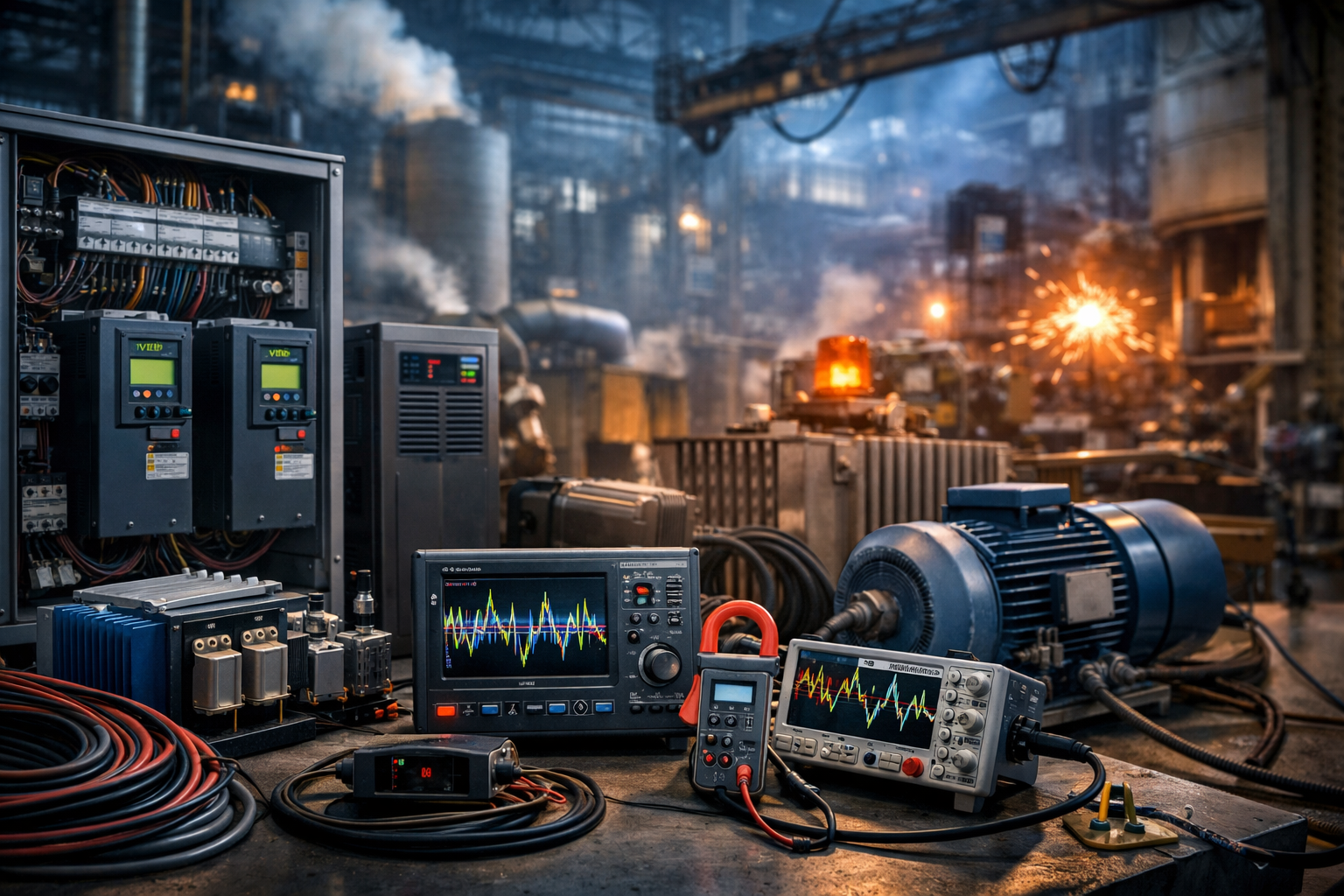
Introduction: The Most Convenient Blame in the Electrical World
When machines trip, drives fail, or sensitive equipment behaves erratically, the first finger usually points outward.
“Utility power isn’t clean.”
“Voltage fluctuations from the grid.”
“Poor supply quality.”
Yet, in most industrial facilities, the uncomfortable truth is this:
Power quality problems rarely originate at the utility. They are created inside the facility itself.
Modern plants are packed with non-linear loads, power electronics, and fast-switching devices. Ironically, the same technologies that improve efficiency, automation, and control are also the biggest contributors to distorted power.
This blog breaks down where power quality really degrades, why utilities are often unfairly blamed, and how industries unknowingly sabotage their own electrical systems.
What “Power Quality” Really Means (Beyond Voltage)
Power quality isn’t just about whether voltage is present.
A “good” power supply means:
Utilities are heavily regulated to deliver power within defined standards (IEC 61000, IEEE 519, EN 50160). By the time electricity reaches your main incomer, it is usually well within acceptable limits.
Problems begin after that point.
Where Power Quality Actually Breaks Down
1. Harmonics: The Silent System Polluter
Harmonics are distortions in the electrical waveform caused by non-linear loads.
Common harmonic generators:
Instead of drawing current smoothly, these devices “chop” the waveform.
Real-life example:
A cement plant using multiple VFD-driven crushers reported frequent transformer overheating. Initial suspicion was poor utility supply. A harmonic study revealed THDi exceeding 38%, causing:
The fix? Passive harmonic filters—not a new transformer, not a utility complaint.
2. Unbalanced Loads: When Phases Don’t Share the Load
In many industrial plants, single-phase loads are unevenly distributed across three phases.
Consequences include:
Even a 2–3% voltage imbalance can reduce motor life significantly.
Real-life example:
A large FMCG manufacturing unit running packaging lines experienced repeated motor failures. Analysis showed one phase consistently carrying 18–20% higher load due to poor DB planning.
No grid issue. Just internal design oversight.
3. VFDs: Efficiency with a Trade-off
VFDs are essential for modern industry—energy savings, soft starting, speed control.
But they also introduce:
Big users like ABB, Siemens, Danfoss, Schneider Electric all clearly state harmonic mitigation requirements in their application guides—yet these are often ignored during execution.
Real-life example:
A steel rolling mill retrofitted VFDs on all auxiliary motors. Energy savings were achieved—but within a year:
Root cause: No line reactors or harmonic filters installed.
4. UPS Systems: Clean Power That Can Dirty the Grid
UPS systems protect sensitive loads—but they can degrade upstream power quality.
Issues introduced by poorly designed UPS systems:
Data centers, hospitals, and control rooms are especially vulnerable.
Real-life example:
A Tier-II data center faced unexplained overheating in its main LT panel. Thermal imaging showed neutral bus temperatures exceeding safe limits. Cause: Triplen harmonics from multiple UPS systems combining in the neutral conductor.
5. Internal Disturbances: Switching, Grounding, and Design Gaps
Some power quality problems have nothing to do with “equipment” and everything to do with engineering discipline.
Common internal disturbances:
Real-life example:
A pharmaceutical plant faced PLC communication errors during motor starts. The issue wasn’t EMI from outside—it was common grounding between power and control circuits.
Utility vs Internal Power Quality: A Reality Check
Where the Problem Actually Comes From
|
Aspect |
Utility Supply |
Inside the Plant |
|
Voltage regulation |
Controlled & regulated |
Affected by load switching |
|
Harmonics |
Minimal (mostly linear loads) |
High due to VFDs, UPS, SMPS |
|
Phase balance |
Balanced at source |
Often unbalanced internally |
|
Neutral loading |
Designed for standard loads |
Overloaded due to triplen harmonics |
|
Power factor |
Maintained by utility |
Degrades with electronics |
|
Fault responsibility |
Shared infrastructure |
Fully under owner’s control |
In short: utilities deliver reasonably clean power. Industries distort it.
Why the “Utility Problem” Myth Persists
What Leading Industrial Players Do Differently
Companies like Reliance Industries, Tata Steel, Intel, Amazon Web Services, Siemens Energy, and Shell treat power quality as a design parameter, not an afterthought.
Common practices:
This is why their facilities scale without electrical chaos.
The Bigger Risk: Latent Damage
Power quality issues rarely cause instant failure.
Instead, they:
By the time failures appear, damage is already done.
Conclusion: Fix the Mirror, Not the Window
If your facility has power quality issues, the problem is almost never “out there”.
It’s in:
The grid delivers power.
Your plant decides what happens to it.
FAQs (Short & Straight)
1. Can poor utility power ever cause issues?
Yes—but it’s far less common than internal disturbances, especially in industrial zones.
2. Do all VFDs require harmonic filters?
Not all—but most medium to large installations benefit from line reactors or filters.
3. How can I detect power quality issues?
Through power quality analyzers, thermal scans, and harmonic studies.
4. Are harmonics dangerous even if nothing trips?
Yes. They cause silent heating and long-term equipment degradation.
5. Who should handle power quality studies?
Qualified electrical consultants—not just panel vendors or installers.
Why Internal Equipment Placement Makes or Breaks Reliability
Read More