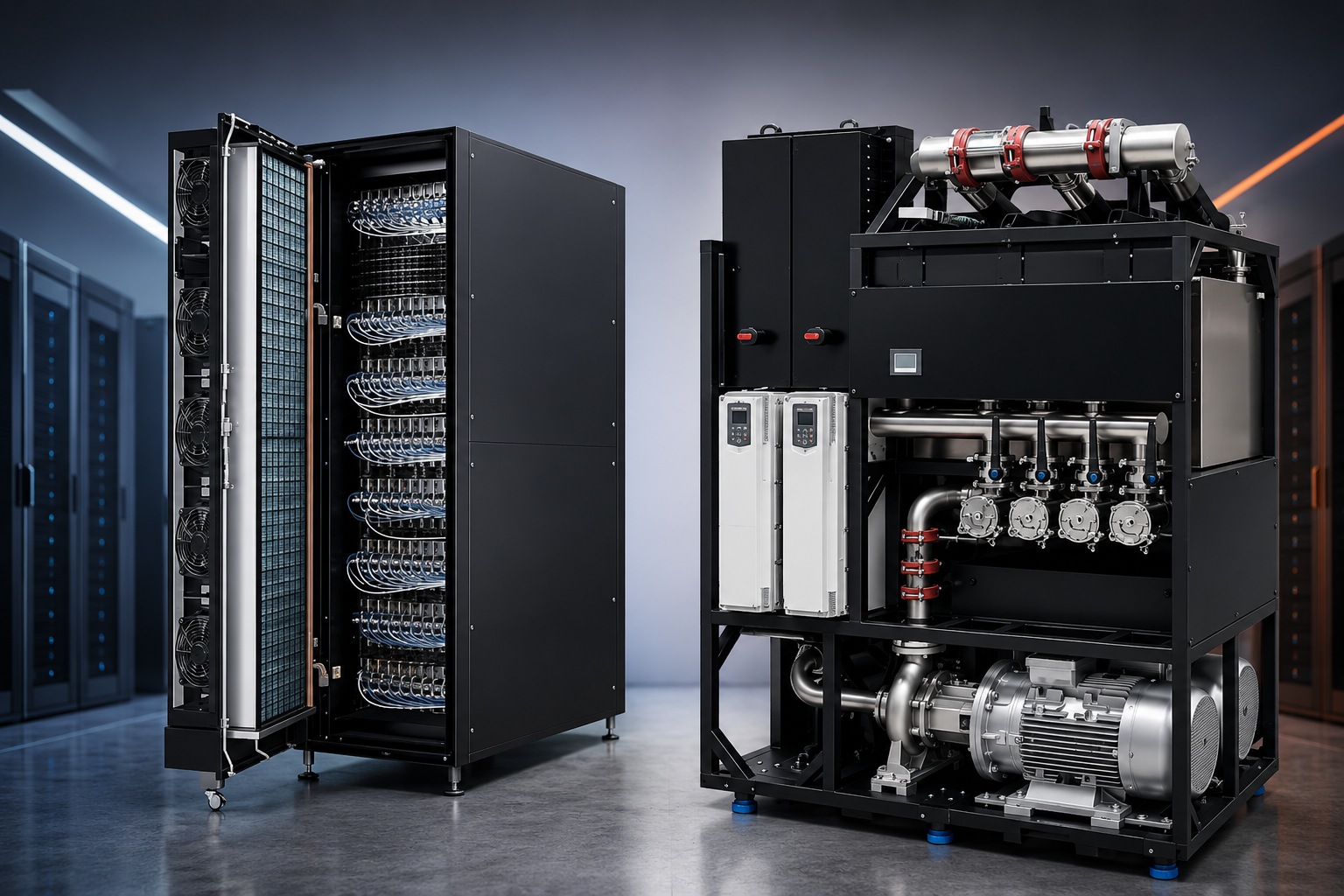
RDHx vs CDU: What's the Difference—and Why You Need BothUnderstanding the Backbone of Modern Liquid Cooling Infrastructure As AI workloads, HPC clusters, and next-generation data centers push rack densities beyond 30–100+ kW, traditional air cooling is approaching its practical limits. Liquid cooling has become the preferred solution—but many professionals still use RDHx and CDU interchangeably. They are not the same thing. One removes heat from the servers. The other enables the entire cooling ecosystem to function. Understanding how they work together is essential when designing high-density IT infrastructure. The Shift from Air to Liquid A conventional server room relies on Computer Room Air Conditioning (CRAC) units and raised-floor airflow. This works well for low to medium density deployments. However, AI GPUs, accelerated computing, and HPC applications generate heat concentrations that air simply cannot remove efficiently. This is where liquid cooling changes the game. Instead of cooling the room first, heat is removed directly at—or very close to—the source. The two key components enabling this are: Rear Door Heat Exchangers (RDHx) Coolant Distribution Units (CDU) Although closely related, they perform completely different functions. What is an RDHx? A Rear Door Heat Exchanger (RDHx) is mounted on the rear of an IT rack. Instead of allowing hot exhaust air to enter the data hall, it passes through a chilled-water heat exchanger integrated into the rear door. The hot air transfers its heat into the water, and the cooled air exits back into the room. In simple terms: Server → Hot Air → RDHx → Heat Removed → Cool Air Returned Key Benefits Supports rack densities up to 80–100+ kW Minimal changes to existing server hardware Maintains familiar air-cooled server architecture Reduces dependence on CRAC units Improves overall cooling efficiency RDHx is often the preferred first step toward liquid cooling because it requires minimal changes to existing IT equipment. What is a CDU? A Coolant Distribution Unit (CDU) is the hydraulic control center of a liquid cooling system. Rather than cooling servers directly, it manages the coolant circulating through RDHx units or direct liquid cooling loops. A CDU typically: Pumps coolant Controls pressure Maintains flow rates Regulates supply temperatures Isolates facility water from IT cooling loops Monitors system health Think of the CDU as the heart that keeps coolant flowing throughout the cooling infrastructure. Without a CDU, liquid cooling cannot operate reliably.
This website uses cookies or similar technologies, to enhance your browsing experience and provide personalized recommendations. By continuing to use our website, you agree to our Privacy PolicyAccept